
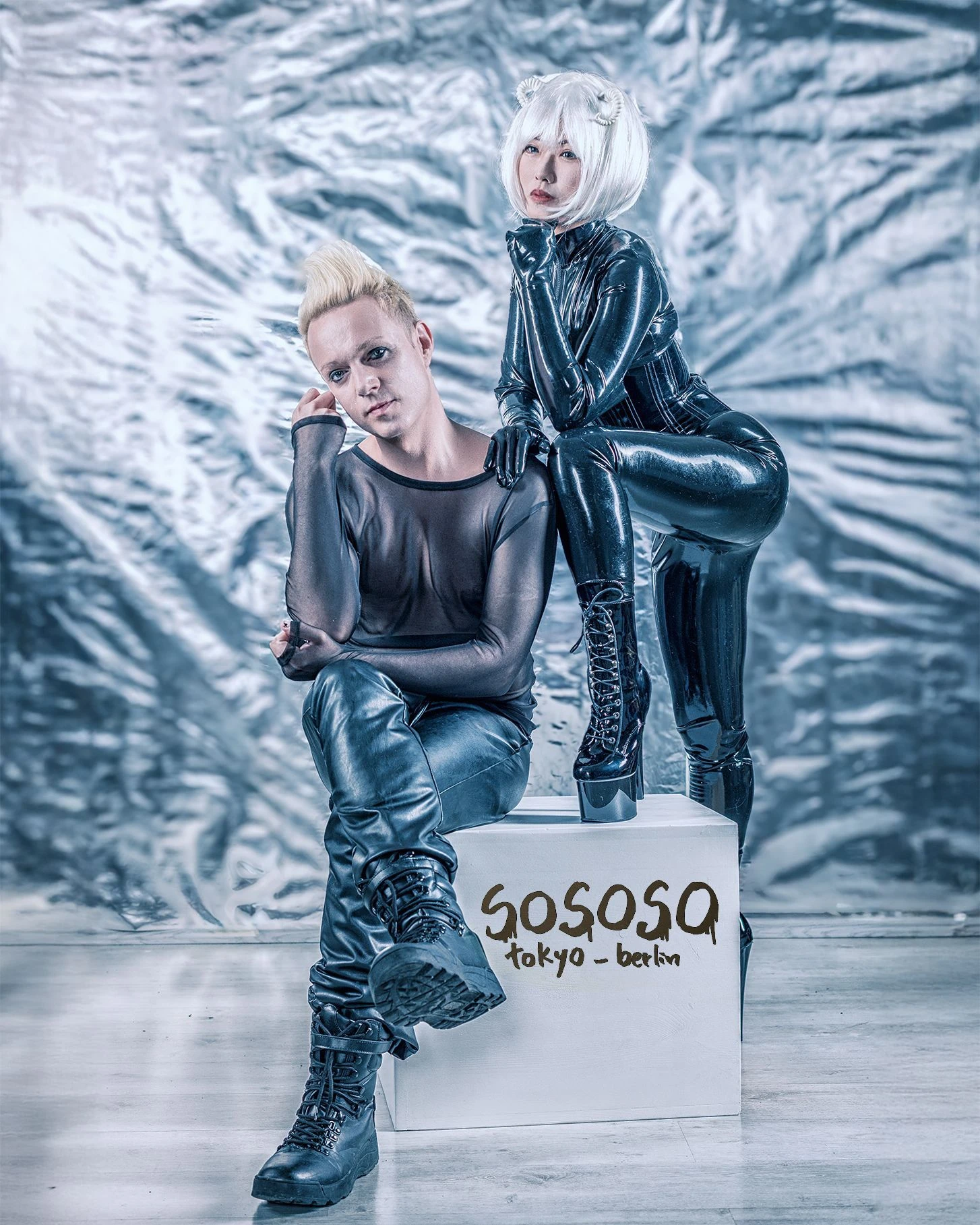
On our most recent trip to DoKomi, we sat down with the German‑Japanese act SOSOSO tokyo_berlin just before they took the stage for the horror showcase “Akuma no Mori.” The act, which roams the European convention circuit, is celebrated for mixing pop, rock, and futuristic punk vibes, plus their strikingly unconventional performances.
Here we share our chat with German producer DRFRT and Japanese vocalist Miyu, diving into the group’s background, their distinctive convention‑stage style, and what fuels their creativity.
Some sections of this interview were subtly adjusted for better readability.
I asked about the meaning behind the name ‘SOSOSO’, as it wasn’t easy to find details online.
DRFTR: Japanese speakers often repeat “so, so, so” when they agree or acknowledge something, and this pattern is used in many languages, including English and German.
During a photo session in Tokyo with Miyu’s friend, he overheard them repeatedly using “so, so, so” in conversation, which inspired the name. They added “tokyo_berlin” as a second moniker to make the act easier to locate online.
Finding information about the duo is tricky because a year ago they faced a choice: focus on social media or devote time to live performances, which they found more enjoyable. Consequently, they have been touring across several countries.
Since you’ve attended numerous conventions, did you choose to put a focus on them?
Miyu: We’re heading to Sicily tomorrow!
DRFTR: We regularly hit conventions, but also adult‑only events, like the one we’re doing tonight at DoKomi’s “Akuma no Mori.”
Are you both residing in Berlin?
Miyu: Yes, we’re based there. I’m originally from Tokyo, but I currently live in Berlin.
How did you two come together?
Miyu: He was searching for a Japanese vocalist. Previously he worked on an Asian‑focused collaboration project, whereas I modeled. When we first met, I told him I couldn’t sing and wondered why he’d reach out. Still, I gave karaoke a shot, and he loved my voice.
I never would have imagined what followed after seeing your show at Iberanime Santarém.
Miyu: Thanks!
DRFTR: She’s quite talented.
Miyu: I love singing, but I’d never pursued it as a career before; I still model on the side.
You clearly invest a lot of energy into both your performances and the visual style of your shows.
DRFTR: I fell for an 80s track I stumbled upon online and found it super cool. Over the years I’ve created music across various genres and languages, but this particular song—its Japanese‑inspired rhythm—struck me especially. We made a video based on it before we officially became SOSOSO.
The shoot happened on May 1st in Berlin, where a massive demonstration—almost a riot—was taking place. I reached out to a filmmaker, and we mingled among the crowd. We captured a moment when a police car passed close enough to nudge my leg, amid a sea of thousands of participants.
The scene felt raw. Eventually police forced the camera and director to the ground, and the unrest erupted. We halted filming but were caught in the crowd for about an hour—it was risky yet exciting.
It marked our first truly high‑energy collaboration, and we’ve kept the project alive ever since.
You had a cross‑cultural endeavor before forming SOSOSO, correct?
DRFTR: Yes, we worked with artists from multiple nations. I just licensed a track to a Chinese label. As a producer I focus more on creating music than on guitar playing. For SOSOSO I compile whatever catches my ear right now into a song; Miyu’s approval is key, and she occasionally suggests ideas herself.
Because we’re playing at conventions, the tracks are designed not for sedentary listening—each piece shifts every minute, letting us adapt to different venues. Over time we’ve rocked metal festivals, dark‑wave gatherings, and shared stages with punk bands back in Tokyo.
Conventiongoers seem to love your performance style, even if they’re new to you—sort of a party vibe.
DRFTR: Absolutely, the energy is electric and it’s a full‑blown entertainment experience, not just music. Both Berlin and Tokyo are unique scenes—different yet sharing a gritty, dark edge. That’s why many of our songs explore somber themes.
What do you find most rewarding about doing conventions?
DRFTR: Conventions let us express ourselves in a playful way, a welcome escape from real‑world stresses. I once saw a protest abroad where participants brandished a One Piece flag.
We even used it for a rally in Peru recently!
DRFTR: It’s a clever protest method—a fun way to tell authorities ‘we disagree with your actions.’ That’s why the idea has spread globally.
How challenging is it to connect with fans online?
DRFTR: We lean on live shows to engage fans. Nowadays you must amplify your content and understand algorithms, but we keep training daily—like a dojo—even when exhausted. That routine lets us stay mobile, as we’ll see on our trip to Sicily.
Have you visited Spain yet? There are plenty of conventions there.
Miyu: Not yet, but I’d love to go!
DRFTR: We just keep performing, and new chances arise naturally.
I first saw you at Iberanime Santarém, which likely happens for many fans. Do you think it’s difficult to manage shows across different countries? In my view, each European nation feels like its own world.
DRFTR: We’re like a chameleon act—we can swap looks, hairstyles, even the whole show. We pick songs based on what we think will click with each crowd, and that eclectic mix mirrors what you see at conventions.
Where do you draw inspiration for your music?
DRFTR: Inspiration can come from virtually any idea.
Miyu: I constantly scan Japanese news on X, Instagram, and TikTok, noting trends and jotting down song ideas that emerge from them.
DRFTR: I then flesh out the final track on my computer. It’s basically just the two of us collaborating on the music.
Miyu: I handle the Japanese lyrics.
DRFTR: I concentrate on the sound, syllables, and related elements.
Interesting. MADKID, another Japanese‑English act, mentioned how each language has distinct sonorities. Do you find it tough to manage both languages?
DRFTR: She’s incredibly multilingual.
Miyu: German feels logical or mathematical to me. When he mixes English pronunciation into Japanese, it sounds foreign, like a gaijin. But if he says it the German way, it sounds Japanese. I also studied French, but I’ve mostly forgotten it; still, I can understand people speaking it.
What are your future plans?
DRFTR: It’s an evolving, organic process where we experiment with new directions. I’m refining our live setup, and while a full band would be great, coordinating everything could be a logistical challenge.
DRFTR: We’re less about rigid plans and more about anticipating the next step.
Finally, could you share a final message with your fans?
Miyu: Thanks a lot for all your support!
DRFTR: Stay positive, especially now when challenges abound. Don’t give negativity room—it won’t take hold. Keep dreaming, keep moving forward, and enjoy life!
Bonus: What’s your favorite anime series?
Miyu: Chainsaw Man and Tokyo Ghoul.
DRFTR: I also love Chainsaw Man, though I haven’t seen the latest movie. Another standout for me is Takopi’s Original Sin—it’s dark yet thoughtfully crafted.
We’d like to thank SOSOSO tokyo_berlin for taking the time before their evening performance at DoKomi. We look forward to seeing them at upcoming European conventions and enjoying their engaging shows once more!
Check out more anime at Latest Anime & manga news.
Thanks for visiting thecuy. 🙂

Saya adalah penulis di thecuy.com, sebuah website yang berfokus membagikan tips keuangan, investasi, dan cara mengelola uang dengan bijak, khususnya untuk pemula yang ingin belajar dari nol.
Melalui thecuy.com, saya ingin membantu pembaca memahami dunia finansial tanpa ribet, dengan bahasa yang sederhana.