
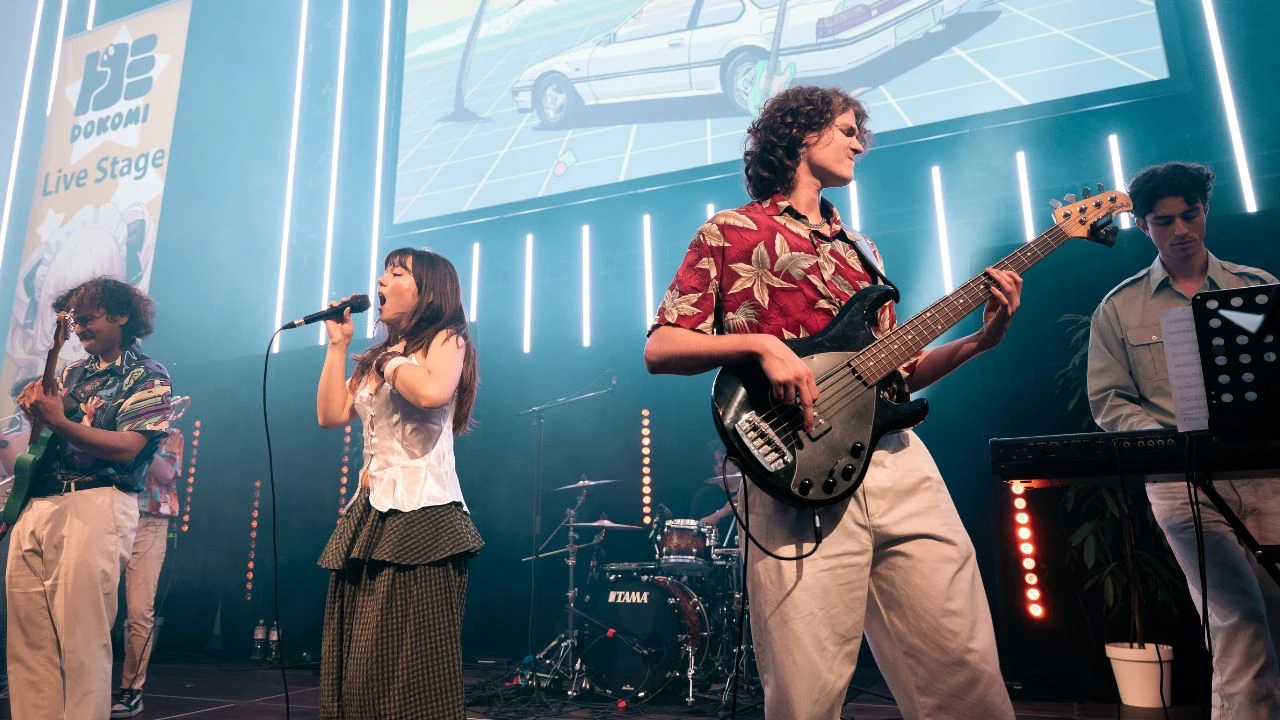
While we were at the German convention DoKomi, we got the chance to sit down with the city‑pop cover band MURASAKI WAVES. The previous weekend the group had taken the main stage of Düsseldorf’s “Japan‑Tag,” a festival that celebrates Japanese culture. At DoKomi, MURASAKI WAVES played the best songs from the city‑pop catalogue on both the Live Stage and the Hana no Machi area.

The ensemble is made up of Lily Aiko Mertens (vocals), Ares Gnauk (guitar), Yannick Bethmann (bass), Kenji Fujii (drums), Raphael Zuber (keys), Finley Münker (trumpet), Alex Hefny (saxophone), Felix Koch (trombone) and Alex Ehret (trombone). In this chat we spoke with them about the band’s origins, today’s city‑pop revival and how they have progressed as a cover group so far.


Portions of this interview have been slightly adjusted for clearer phrasing.
Q: What does the name ‘MURASAKI WAVES’ stand for?
Yannick: We began without a name, which many groups do, but we needed one for performances. We tossed around ideas and landed on the Ghibli movie Ocean Waves. Since we wanted a Japanese cultural reference, we swapped “ocean” for “murasaki,” the word for purple in Japanese.
Raphael: We also thought that ‘MURASAKI WAVES’ captured how city pop lyrics mix Japanese and English. He added that purple is the color online fans most often link to the genre.
Q: Did you decide to perform city pop from the start?
Yannick: From day one we focused on city pop because we wanted to preserve its original vibe. Ares, who was already in another group, introduced me to the sound, and during lockdown I dove deep into it, listening together with Kenji and the rest. We found the style energetic and enjoyable. We also knew locals who could help us start a cover band for this music; many were new to city pop but loved it instantly. We began with a handful of tracks, played them live and had a great time.
Q: How would you explain the current “revival” of city pop?
Yannick: Yannick believes the resurgence is tied to online culture and viral trends. The clip of Mariya Takeuchi’s “Plastic Love” went viral around 2018, marking the first wave of city pop exposure for many non‑Japanese fans. To Japanese listeners, however, it feels like their 80s rock era.
Lily: Lily points out that city pop connects with Western audiences thanks to today’s love for Japanese pop culture. Anything Japanese is seen as trendy. Additionally, younger listeners are nostalgic for past decades—70s, 80s, even 90s and early 2000s, which are experiencing a revival.

Q: There’s an anime currently airing where they performed ‘Plastic Love’ [ending theme of Gals Can’t Be Kind to Otaku!?’s Episode 6].
Ares: Ares observed that many Japanese fans were unaware of the artists and tracks that gained fame via the internet‑driven city pop revival. He finds it great that these songs are being rediscovered and attracting larger fan bases.
Q: There’s an artist in DoKomi who does prints with a city pop aesthetic. I bought a print two years ago.
Lily: Lily noted that the creator, Mizucat, designed their official logo.
Raphael: Raphael added that Mizucat also shot the band’s debut photos.
Lily: The photos are amazing.
Raphael: Raphael explained that Mizucat brought her white car for the shoots, which appears in many of their Instagram pictures.
Q: Did you know before you started with the band?
Raphael: Raphael explained that Jannik reached out to Mizucat via Instagram.
Lily: Lily said that Mizucat blends anime style with the vintage look of the 70s and 80s, which perfectly matched the band’s aesthetic.
Raphael: He added that they remain very pleased with both the photos and the logo.
Q: I also saw that you performed at Japan Tag last week [before DoKomi]. Is it like a convention?
Raphael: Raphael described Japan Tag as a city festival run by Düsseldorf for nearly two decades. It features stalls along the Rhine riverbank and three stages hosting music, dance, traditional Japanese instrument performances, as well as sports and martial arts.
Yannick: Yannick explained that they contacted the organizers directly and debuted at Japan Tag two years ago. Unlike the anime‑focused DoKomi, Japan Tag highlights traditional Japanese music, clothing and other cultural activities.
Raphael: He noted that cosplay and anime are still big parts of the event, but for the band Japan Tag works better because it lets them concentrate more on city pop.
Q: What do you think about city pop being ‘modern’ yet ‘traditional’ at this point?
Lily: Lily observed that when city pop first appeared in Japan, it was seen as a Western import. Japanese artists were suddenly creating pop music that mixed Japanese and English lyrics. In that sense, only the use of Japanese could be called “traditional,” because the sound itself is pop‑oriented and Western‑style.
Yannick: Yannick noted that after World War II many aspects of Japanese culture faded as Western‑American technology spread, influencing everything from industrial design to everyday life. While some welcomed the change, others felt Japan should have kept more of its heritage. He believes city pop is a genre Japan made its own, adding a unique flavor to Western pop influences.
Q: You know a lot of the city pop’s roots. Not everyone researches the heritage of the music they are playing.
Raphael: Raphael added that when they perform city pop today, the music feels old to them but fresh to many listeners. This mix of nostalgia and novelty makes the show compelling, unlike a straightforward cover of ABBA or the Bee Gees. It offers something new while sounding familiar, which he thinks is why it resonates more.
Ares: Ares explained that the 70s‑80s sounds also form the foundation of current Japanese pop and anime music. If you examine chord progressions, about 90 % appear in city pop, making it harmonically rich. The synth aesthetics of the era still sound modern today, and the “retro‑futuristic” trend is gaining momentum. He believes old recordings retain their high quality and charm.
Raphael: Raphael added that the whole cultural backdrop—Japan’s economic boom, new technologies, and the fading of traditional customs—still fascinates many young fans. Today’s listeners are drawn to the nostalgia of a time when the future felt exciting, creating a kind of “nostalgia for the futuristic.”
Q: Have you felt that the attention to city pop has been growing?
Lily: Lily said the genre seemed to peak during the pandemic and has maintained its popularity since. As a subculture, city pop has always existed beneath the surface.
Yannick: Yannick noted that while it’s hard to quantify current interest, the viral spread of “Plastic Love” and “Stay With Me” sparked the biggest surge. Those two tracks remain the most recognizable city pop songs online. He observes that many concertgoers are new to the sound, while others are thrilled to finally see these songs performed live. That excitement is exactly what the band aims to deliver.
Raphael: Raphael mentioned that locally the scene has been gaining momentum. Their bookings have moved from smaller venues to larger ones like Japan Tag and DoKomi. This year they played to a bigger crowd than two years ago. There were no other city‑pop cover bands when they started, and the local audience for the genre has grown noticeably.
Q: What is the hardest part of being a band?
Lily: Lily pointed out that the group is sizable, with eight members including three brass players. Coordinating practice schedules so everyone can attend is the biggest challenge.
Raphael: Raphael said they don’t earn money from the performances, so each member also holds other jobs. Finding time to rehearse and play live is therefore quite demanding.
Q: Now that you mention it, what do you do outside music?
Raphael: Raphael explained that his studies focus on economics and political science for a master’s degree.
Ares: Ares is majoring in jazz bass as a passion project, but works in a wine store to support himself.
Yannick: Yannick lives with Ares and occasionally helps with his side projects.
Lily: Lily is pursuing an art degree at the Dusseldorf Art Academy. She started studying in 2023, the same year the band formed, and finds it rewarding to balance art school with the band’s activities.
Kenji: Kenji is studying marketing and management while also working as a freelance musician and on various other projects. He also plays in a separate band that writes original music.
Yannick: Yannick works in IT at Vodafone. While it can be stressful at times, it provides financial stability that helps the band. He compares being in a band to being in a relationship, emphasizing that communication is essential. With many members come diverse ambitions and backgrounds, and solving problems together can be tough, but good communication is the foundation for overcoming challenges.
Ares: Ares added that nobody is as organized as Kenji, and that a lack of a driving, organizing force is often what causes bands to dissolve. Such leadership is crucial for keeping the group cohesive.
Raphael: Raphael noted that planning a gig involves a lot of coordination—sending emails, discussing logistics, budgeting, song selection, arranging pieces, and finding rehearsal time. Someone needs to oversee all these tasks for the band to function smoothly.

Q: Have you ever considered producing an original city pop song?
Raphael: Raphael explained that, except for himself, all current members also work on other musical projects with original material in different styles. As a city‑pop cover band they aim to focus on live performances and faithful renditions. He compared imitating a past genre to painting in Michelangelo’s style today—possible but not essential, given the wealth of authentic city‑pop recordings already exist. Therefore, creating new city‑pop‑styled music would feel like duplicating rather than innovating.
Raphael: He added that art emerges from specific contexts. To create music today you need a contemporary approach; trying to sound like a past era limits creativity.
Q: Do you have a goal for the near future? A place you would like to perform?
Ares: Ares simply said “Japan” and the others agreed.
Lily: Lily noted that three months ago they would have answered “Japan Tag’s big stage,” but they have already performed there.
Yannick: Yannick recalled joking in rehearsal that they might hit a major stage “once in ten years,” but they were happy to have that chance already. While the process remains the priority, Japan is still seen as the ultimate milestone. They also hope to play in other European countries, such as Spain, expanding beyond Germany.
Q: Finally, could you share a message to your fans?
Yannick: Yannick encouraged fans to be inspired, create music, make art, cook, program, or simply make something. He believes anything is possible with the right environment and people.
Lily: Lily added that having the right people around makes success obvious. She feels that with the proper support, anything can be achieved.
Ares: Ares thanked the fans, saying many sweet supporters have attended shows over the years. Knowing they can bring happiness makes the effort worthwhile.
Raphael: Raphael expressed gratitude for the Instagram comments, concert attendance, T‑shirt purchases, autograph requests, and fan gifts. He urged fans to keep supporting and attending more shows.
Yannick: Yannick concluded that music is a platform for human connection and love, and he believes love always wins.
We extend our gratitude to MURASAKI WAVES for granting this interview. As enthusiasts of Japanese culture, we enjoyed witnessing their vibrant city pop performances live. We’re excited to see them on stage again in the near future.
If you happen to be in Germany, make sure to keep an eye out for any upcoming shows by MURASAKI WAVES in your area!
Baca juga artikel anime terbaru lainnya di Info Anime & manga terbaru.
terimakasih sudah mengunjungi thecuy. 🙂

Saya adalah penulis di thecuy.com, sebuah website yang berfokus membagikan tips keuangan, investasi, dan cara mengelola uang dengan bijak, khususnya untuk pemula yang ingin belajar dari nol.
Melalui thecuy.com, saya ingin membantu pembaca memahami dunia finansial tanpa ribet, dengan bahasa yang sederhana.