
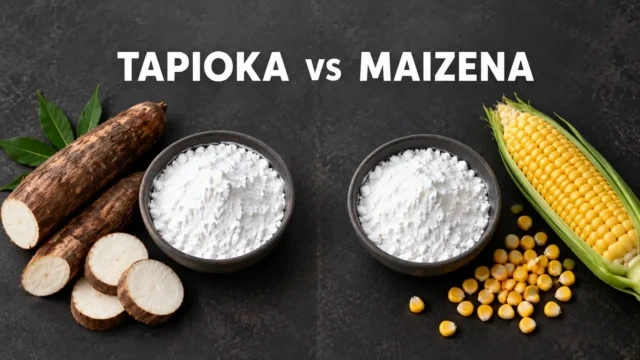
The most fundamental difference between tapioca and cornstarch lies in their raw materials and the texture they produce. Tapioca is a starch extracted from cassava and generally yields a chewy, elastic, and glossy appearance. In contrast, cornstarch, derived from corn, is better suited for thickening sauces, softening pastries, or creating a light, crispy coating for fried foods.
Both are white powders and can act as thickeners. However, tapioca and cornstarch are not always interchangeable, as the final outcome, thickening power, and stability during cooking can vary.
Summary of Differences Between Tapioca and Cornstarch
| Aspect | Tapioca Flour | Cornstarch |
|---|---|---|
| Raw material | Starch from cassava roots | Starch from corn kernels |
| Other names | Cassava starch, sago flour, or aci | Cornstarch or corn flour |
| Result after cooking | Chewy, elastic, slightly sticky | Thick, smooth, and firmer after cooling |
| Appearance | More transparent and glossy | Tends to be cloudy or opaque |
| Primary uses | Cilok, cireng, pempek, bakso, boba, and gluten‑free pastries | Sauces, soups, vla, pudding, cakes, and crispy coatings |
| If used excessively | Can become overly tough or sticky | May feel dense, chalky, or lumpy |
What Is Tapioca Flour?
Tapioca flour is a starch extracted from cassava roots. According to FAO AGROVOC, tapioca is a starch obtained from cassava plant roots. The general manufacturing process involves crushing cassava, separating starch from fibers, sedimentation, and drying.
Although commonly called flour, tapioca is more accurately classified as a starch. Its fiber and non‑starch component content is much lower than that of flour made by grinding whole food.
When heated with liquid, starch granules absorb water, swell, and thicken the mixture. Studies on starch gelatinization explain that heating starch in water causes granules to swell and their internal structure to change, increasing viscosity.
What Is Cornstarch?
Cornstarch (commonly called maizena in Indonesia) is a corn‑derived starch. It is not whole‑grain corn flour because the hull, protein, and most other components of the corn kernel are removed to isolate the starch.
Cornstarch is widely used as a thickening agent, gel former, and water binder. In home cooking, it is commonly found in capcay sauce, thick soups, sweet and sour sauce, vla, pudding, and cake dough.
Main Differences Between Tapioca and Cornstarch
1. Derived from Different Plants
Tapioca is obtained from cassava roots, while cornstarch comes from corn kernels. This difference in plant source influences granule structure and the amylose‑to‑amylopectin composition.
The FAO notes that starch sources can be cereal grains such as corn and rice or roots such as cassava. Granule size and gelatinization temperature can differ depending on the plant source.
2. Tapioca Is Chewier and More Elastic
Tapioca is the preferred choice when a dish requires a chewy, flexible, or slightly sticky texture. It is therefore widely used in cilok, cireng, pempek, bakso, boba, and various traditional snacks.
Cornstarch does not produce the same level of chewiness. After cooling, corn starch tends to form a shorter, softer, and firmer texture. This characteristic makes it suitable for vla, pudding, pie fillings, and sauces that need to adhere to food without being too elastic.
3. Cooked Dish Appearance Differs
Tapioca paste tends to appear more transparent and glossy. Studies on tapioca characteristics also describe natural tapioca starch as a material that can form a clear, cohesive, and slightly extensible paste.
Cornstarch usually produces a more opaque or cloudy color. This difference is important when making fruit sauces, pie fillings, or other dishes that need to retain bright colors. For clear and shiny sauces, tapioca is usually more suitable. For savory sauces that don’t require clarity, cornstarch is more practical.
4. Thickening Power Varies
Cornstarch generally provides strong thickening with relatively little quantity. Tapioca is also effective as a thickener, but the amount required can vary according to brand, product type, liquid quantity, sugar content, and the dish’s acidity.
Therefore, there is no single substitution ratio that works for all recipes. Some guides use a 1:1 ratio, while others recommend slightly more tapioca than cornstarch. For homemade sauces, start with equal amounts, then add a little more if the result is still too thin.
5. Different Response to Heat
Tapioca thickens relatively quickly and should not be cooked for too long after the desired texture is reached. Excessive heating and stirring can make it too sticky or reduce its thickness.
Cornstarch needs to be heated to gelatinize the starch and remove any raw taste. However, cornstarch sauce also does not need to be boiled for too long. After the sauce thickens and no longer feels grainy, reduce the heat or stop cooking.
What Are Tapioca and Cornstarch Good For?
Use Tapioca Flour For:
- Making cilok, cireng, cimol, and pempek.
- Adding chewiness to bakso or meat dishes.
- Creating boba and traditional chewy pastries.
- Providing elasticity in gluten‑free flour blends.
- Thickening fruit sauces that need to stay glossy.
- Producing a crispy fried coating with a slight chewy character.
Use Cornstarch For:
- Thickening soups, capcay, and stir‑fry sauces.
- Making vla, pudding, custard, or cake fillings.
- Softening the texture of cookies and cakes.
- Coating chicken, tofu, or vegetables for extra crispiness.
- Reducing gluten formation when mixed with wheat flour.
- Creating a thick sauce without overly sticky texture.
For fried foods, the best choice depends on the desired outcome. Cornstarch helps create a light, dry, and flaky coating. Tapioca tends to give a harder crispness or a chewy texture if used in large amounts. Both can also be blended with wheat flour or rice flour.
Can Tapioca Replace Cornstarch?
Tapioca flour can replace cornstarch in many sauces, soups, and fruit fillings, but the result will not be identical. The NC State Extension substitution guide lists 1 tablespoon of cornstarch replaced by 1 tablespoon of tapioca starch as a starting point.
However, products and recipes can yield different results. Some manufacturers also recommend a ratio of about 3 parts cornstarch to 4 parts tapioca. Because of these variations, follow these steps when substituting:
- Start with a 1:1 ratio for small‑quantity sauces.
- Dissolve the starch in cold liquid before adding it to the dish.
- Heat while stirring until the thickness is apparent.
- Add tapioca gradually if the sauce is still too thin.
- Stop heating once the texture is correct to avoid making the sauce too sticky.
Substitution is riskier for recipes that rely on a specific structure, such as cilok, boba, cookies, and gluten‑free breads. In such recipes, replacing all tapioca with cornstarch can remove the desired chewiness or elasticity.
How to Use Tapioca and Cornstarch Without Clumping
Do not pour dry tapioca or cornstarch directly into hot broth. The outer part of the starch will thicken first and encase the still‑dry powder, forming lumps.
Use the slurry technique with the following steps:
- Mix one part starch with about one to two parts cold water.
- Stir until all the powder dissolves and no hard sediment remains.
- Pour the solution slowly into the hot dish while continuously stirring.
- Wait until the thickness develops before adding the next portion.
- Stir the starch solution again if it has been left to settle, as starch tends to settle easily.
Are Tapioca and Cornstarch Gluten‑Free?
Cassava and corn are not part of wheat, barley, or rye, so pure starch from either is naturally gluten‑free. However, people with celiac disease or severe sensitivity should still choose products labeled gluten‑free to reduce the risk of cross‑contamination during production.
As a reference, FDA gluten‑free labeling requirements stipulate that a food labeled gluten‑free must contain less than 20 parts per million of gluten and must not intentionally use gluten‑containing grains.
Frequently Asked Questions About Tapioca and Cornstarch
Is Tapioca Flour the Same as Tapioca Starch?
In everyday Indonesian usage, ‘tepung kanji’, ‘aci’, and ‘tapioca flour’ usually refer to the same cassava starch. Check the ingredient list on the packaging to ensure the product contains only cassava starch.
Which Is Better for Thickening Sauces?
Cornstarch is suitable for savory sauces that need a smooth and stable thickness, such as capcay sauce or sweet and sour sauce. Tapioca is more appropriate if you want a sauce that is clear, glossy, and slightly elastic.
Which Is Crunchier for Fried Foods?
Cornstarch usually produces a light, dry, and crispy coating. Tapioca can also be crispy, but its texture can be harder or slightly chewy. For a balanced result, both starches can be used as part of a coating flour blend.
Can Cornstarch Be Used to Make Cilok?
Cornstarch can be added in small amounts, but it is not suitable as a main replacement for tapioca in cilok. Cilok requires the elastic and chewy character of cassava starch. If all tapioca is replaced with cornstarch, the texture tends to be more brittle and less chewy.
Conclusion
The difference between tapioca and cornstarch lies in their starch source and the resulting dish characteristics. Tapioca, derived from cassava, excels at creating chewy, elastic, clear, and glossy foods. Cornstarch, derived from corn, is better suited for thickening sauces, softening pastries, or creating a light fried coating.
Both can substitute for each other in some simple recipes, but the final texture may change. Use tapioca for dishes that require chewiness and choose cornstarch when you want a smooth thickness without excessive stickiness.
Find more tutorials at Seputar Tutorial Page.
Thank you for visiting thecuy. 🙂

Penulis Berpengalaman 5 tahun.