
Sparks of Tomorrow shines as a fresh and imaginative entry in this season’s crowded roster of new anime series. Produced by the renowned Kyoto Animation studio, the show adapts Hiro Yuki’s light novel 20th Century Electricity Catalog, illustrated by Kazumi Ikeda, with artistic direction and background work by Momoka Nagatani. Set in an alternate early‑20th‑century Japan, the narrative reimagines a world where steam dominates technology and electricity feels as magical as sorcery. Through its characters, the series probes the concept of an “Age of Electricity” while also delving into themes such as devotion, allegiance to loved ones’ ideals, existential nihilism, and the inventive spirit of a groundbreaking era.
At Anime NYC we, together with fellow journalists, got to chat with two key crew members: the composer Ginger Root, who penned the ending theme, and Art Director Mao Takayama. Their discussion delved into how they worked and what sparked their creative choices while contributing to the project.

Parts of this interview were slightly trimmed for smoother reading. The conversation was facilitated by an interpreter for Takayama‑san’s replies.
The Natural Aristocrat: In your opinion, which scene best showcases the series’ visual identity? Which area demanded the most visual research?
Takayama-san: For me, the most representative scene is the one displaying the Kyoto cityscape. The vintage buildings, the network of pipes, the skyline, and the slightly damp ground all together illustrate the series’ muted, misty, fog‑laden atmosphere.
Adult Swim Central and Toonami Faithful: Takayama-san, the background art feels quite distinctive for an anime. How did you and your team develop this unique visual approach?
Takayama-san: Our focus when crafting the backgrounds is to mimic the look of an oil painting as closely as possible. We pay close attention to brushwork, and because it’s a collaborative effort, we maintain constant dialogue among team members. Once a piece is completed, we discuss whether it meets our standards and refine any elements that could be improved, all to achieve that painterly style.
Unknown Outlet: Sparks of Tomorrow blends a striking visual style with a distinctive musical soundtrack. In developing the ending sequence and the anime’s overall mood, how did the artwork and the music interact and enhance each other?
Ginger Root: I wrote the track without seeing any of the ending animation. The director supplied me with a painting and a brief describing his vision, plus some online chats. I didn’t have concrete visuals aside from that painting and his guidance. I deliberately crafted sections of the song—breaks, drum hits, interludes, choruses—to give the animation room to create something special. Seeing the final result was thrilling; it aligns really well. Ideally the whole song would have an animation, but they animated to what I wrote, which feels special to me. That’s my perspective.
Takayama-san: The ending art was largely created in 3D, with only three segments resembling traditional paintings. Consequently, the background team’s hands‑on work was limited. Before we started, we listened to the song and felt it perfectly captured the series’ eerie tone. The instrument sounded like a pipe organ, which we thought complemented the atmosphere.
Animation Spaces: Takayama-san, the series’ backgrounds for Sparks of Tomorrow beautifully portray the shift in 1906 Kyoto, especially the interplay between traditional wooden houses and the new electric illumination. How did the team reconcile historical accuracy of the Meiji period with Kyoto Animation’s unique artistic style?
Takayama-san: Our approach centered on preserving the artwork’s brushstrokes, drawing inspiration from impressionism and intentionally softening lines to create a dreamy quality. Yet for the Kyoto cityscape—which many viewers might find unfamiliar—we emphasized clear outlines, especially for traditional buildings and notable structures. In each scene we carefully balanced these two approaches, adjusting each cut to maintain harmony between the stylized art and the period details.
Anime Corner: Takayama-san, how much did you rely on historical references when building the series’ setting? Which real‑world elements did you retain, and where did you choose to diverge from reality?
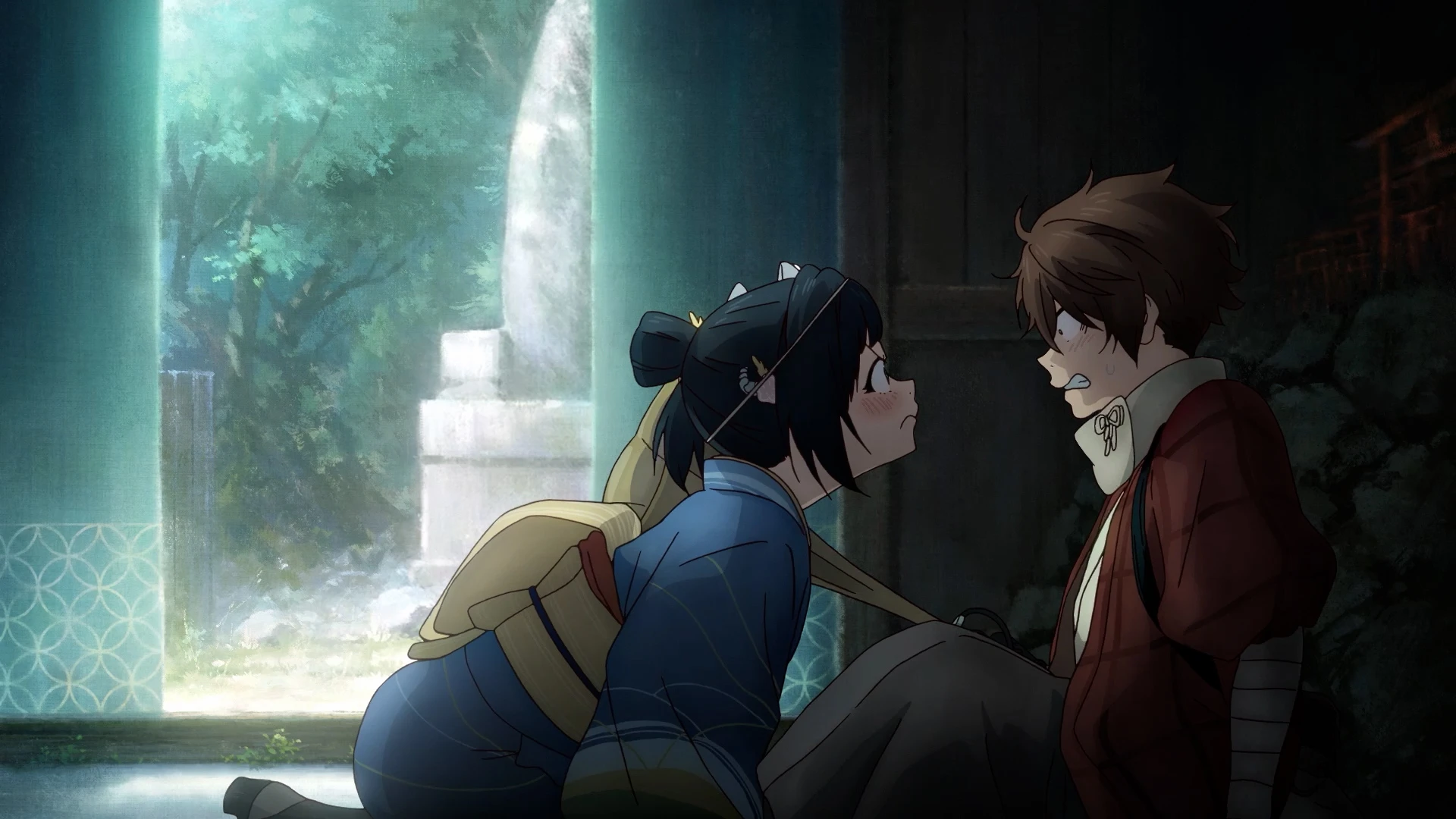
Takayama-san: Following the director’s guidance, we aimed to keep the Kyoto cityscape as faithful as possible, avoiding unnecessary alterations. We strove for authentic architectural details in the buildings. Our deviations focused on steampunk features: the network of pipes across the city and the added mist to evoke a steam‑era feel. Notably, we also replaced historic clotheslines—originally accurate—with pipes, but added more fabric over them to maintain the obscured skyline effect present in the world.
Anime Trending: Takayama-san, many studios outsource background art, but Kyoto Animation has its own in‑house team. How does this internal structure affect the studio’s culture and the quality of its work?
Takayama-san: The biggest benefit of an in‑house team is the ease of communication. Describing a desired scene can be tricky to put into words, especially when the director’s vision is abstract. By being able to sketch directly with the background artists, we can convey ideas instantly, which streamlines collaboration. This is especially crucial for a project with such a distinct atmospheric style, and I believe work of this caliber can only be achieved within a studio like KyoAni.
Yatta-Tachi: Ginger Root, you’ve experimented with unusual tools for sound creation, such as using an old rotary phone as a mic and recording on tape. Which of these quirky instruments is your favorite? Did you incorporate any of them while recording “Soarin’”?
Ginger Root: I composed “Soarin’” entirely in a bedroom, without renting any studio time, which gave it a lo‑fi vibe similar to many of my other tracks. I reused the same rotary phone for some vocal recordings. Working on anime projects makes me cautious about frequent changes, so I learned from past experiences—like an NHK commission earlier this year—to avoid recording many real sounds. Instead, I opted for direct, easily editable recordings for this song, which helped when two versions (short and long) were needed. After finalizing the short version, I had to recreate its sounds for the long version, but thankfully no further tweaks were required after the initial draft.
Adult Swim Central and Toonami Faithful: Ginger Root, what discussions or interactions led to “Soarin’” becoming the ending theme for the series?
Ginger Root: I first thought the offer was a joke, but being an anime fan, I jumped at the chance. During a team meeting with director Ota‑san, we discovered a shared interest in Lady Gaga, which—subconsciously, I think—shaped the song’s direction. He gave me a painting, a written outline, and emphasized that the ending theme should sound electronic, contrasting the opening’s traditional, adventurous feel. This reflected his vision of a future hinted at by the electricity catalog. We exchanged ideas, and I crafted something I felt matched the concept, which the team ultimately embraced.
Unknown Outlet: Both of you, the series finale’s closing moments set the tone for viewers’ week‑long anticipation. What specific emotion or lingering idea do you hope the audience retains after each episode ends?
Ginger Root: The brief was to capture the vibe of a classic ending theme like City Hunter’s “Get Wild”—with a sudden beat drop after some dialogue. Since the story’s mysteries aren’t fully resolved, I aimed for an atmosphere of ambiguity, much like the steam‑filled, smoky city. The lyrics speak of moving beyond the stars and rising above the mist “together.” The animation lets the characters literally soar off the screen, reinforcing that sense of upward flight.
Takayama-san: I largely agree with Ginger. In addition, I want the finale to provoke thought—prompting viewers to reflect on the episode’s events and anticipate what lies ahead, leaving those questions lingering in their minds.
Animation Spaces: Ginger Root, your music often draws on retro Japanese city pop, Showa‑era TV vibes, and analog synths. How did you adapt your characteristic sound to fit the early 1900s Meiji setting and the feeling of soaring wonder experienced by Kihachi and Inako while composing “Soarin’”?
Ginger Root: It was a chance to broaden my musical horizons beyond my usual retro Japanese influences. When I discussed the project with the team, I asked whether they wanted a traditional anime‑style track or a genuine Ginger Root piece. They leaned toward the latter but acknowledged it might be unrealistic, so I settled on a 70% Ginger Root blend with a 30% anime element. This experiment felt like trying on a new look, and the result fits well. Inspired by Ota‑san’s writing, his painting, and the character designs, I treated the song as a metaphor for a boy‑meets‑girl narrative—starting with a solitary instrument representing loneliness, then gradually layering in supporting elements that build toward a full choir in the chorus, symbolizing teamwork. It was a fun challenge, and I hope to repeat it.
Anime Corner: Ginger Root, you mentioned focusing on themes and emotions while creating the ending theme. Which characters from the early parts of the series were foremost in your mind, and what central ideas seemed most suited for a musical piece?
Ginger Root: The sense of wonder presented by the story struck me as a core theme—it’s a familiar setting that hasn’t been deeply explored before. I chose chords that convey an unfinished feeling, reflecting the series’ and song’s ongoing nature. The characters each embody a desire: avenging a sibling, emulating a parent, or simply pursuing personal goals. This universal drive—that we all want something and often can’t succeed alone—became the emotional backbone of the ending theme, echoing both the narrative and the team’s guidance.
Anime Trending: Takayama-san, what is the most valuable advice you’ve received about creating background art?
Takayama-san: The key lesson I’ve learned is to stay mentally engaged while drawing. Since background art supports the characters in the foreground, it needs to guide the viewer’s attention effectively. Constantly reflecting on what you’re creating helps achieve that balance.
Yatta-Tachi: Takayama-san, when did your drawing journey begin, and which artists have shaped your path as a background artist?
Takayama-san: I started drawing at around five years old and have continued ever since. However, the turning point came at age fourteen when I visited an exhibition by Nizo Yamamoto, the art director behind classics like Castle in the Sky and Princess Mononoke. Seeing his work ignited my desire to become a background artist, and his creations remain a major source of inspiration for me.
The Natural Aristocrat: Takayama-san, what has been the most significant shift for you moving from a background artist on Violet Evergarden the Movie (2020) to serving as art director for Sparks of Tomorrow?
Takayama-san: When I worked on Violet Evergarden, I was still early in my career—around my second year—so I was constantly receiving feedback and striving to meet my supervisors’ expectations. Now, as an art director, the dynamic has reversed: I’m the one issuing guidance to the team. This change has allowed me to apply the lessons I gathered as an artist, shaping both my role and the workflow.
Adult Swim Central and Toonami Faithful: Takayama-san, what was your experience like stepping into the role of art director for the first time?
Takayama-san: It was extremely challenging. As an art director, I’m not only responsible for creating the artwork but also for communicating with the team. Many new duties—beyond just drawing—became crucial, and navigating these responsibilities felt quite demanding.
Unknown Outlet: Takayama-san, color choices heavily influence a series’ mood. Did you develop particular color guidelines or lighting methods for Sparks of Tomorrow to distinguish intense drama from calmer everyday moments?
Takayama-san: Our coloration approach remains consistent whether the scene is serious or relaxed, focusing on a muted, cloudy palette. The primary distinction lies in the brushwork: dramatic moments employ stronger strokes, while quieter scenes use softer, gentler touches. These were the key elements we emphasized.
Animation Spaces: Takayama-san, the series showcases vivid moments like Kihachi’s wingsuit flight, city smoke, and electric lanterns. Which specific scene or detail from the first three episodes proved especially rewarding or demanding for the team to realize?
Takayama-san: While it wasn’t a visually spectacular moment, the scene where Kihachi contemplates a futuristic cityscape required considerable effort. Depicting the bustling, realistic crowds and separating their movement from the background proved to be a very labor‑intensive process. I found the thought and execution behind that scene particularly noteworthy.
Anime Corner: Ginger Root, did the collaboration on “Sparks of Tomorrow” influence your typical approach to instrumentation, song structure, and creative workflow?
Ginger Root: Absolutely. The director’s request for a more electronic sound pushed me to balance my personal synth preferences with what best served the story—a fun creative challenge. Additionally, I had to produce an 89‑second version first to sync with the animation, then expand it, which is something I rarely do. Typically I write songs from start to finish in one go, but this project forced me to hit a checkpoint for approval. I also had to recreate guitar tones by ear since I hadn’t saved the original files, adding another layer of complexity that I’m looking to streamline in future work.
Anime Trending: Ginger Root, your music, visuals, and the narrative of Sparks of Tomorrow all touch on creativity and perseverance. Have you ever experienced burnout or a creative block, and what strategies help you stay motivated while handling multiple projects?
Ginger Root: I definitely burned out last year. In the midst of it, I had to remind myself why I started making music—to have fun and enjoy the process. I never imagined I’d be discussing my song at an anime expo. Now I’m grateful for these opportunities. To combat creative blocks, I find walks incredibly helpful. I used to judge myself harshly if a song wasn’t finished in one night, but I’ve become more lenient, allowing myself days or even weeks to step away and return with fresh eyes. Sometimes a song sounds terrible at first, but after a good night’s sleep it feels much better. It’s important to be kind to yourself; motivation fluctuates, and remembering your original passion can bring back the inspiration when it’s needed.
Yatta-Tachi: Ginger Root, what’s your background with Kyoto Animation’s productions, and how do you feel about collaborating with the studio on this song?
Ginger Root: I’m a huge fan of Kyoto Animation’s works, including titles like K‑On!, Nichijou, and Violet Evergarden. Watching Violet Evergarden with my mom was touching—she even cried! I also learned Japanese during COVID and my first read was Hibike! Euphonium, which I later discovered was also an anime by Kyoto Animation. It’s surreal to now be collaborating with the same studio that created those series. It feels truly special, and I’d love the chance to contribute an opening theme someday. As a fan, it’s an amazing opportunity, and I’m hopeful for future projects. Perhaps one day, with enough practice—or maybe a lesson from Takayama‑senpai—I could even create my own anime in about fifteen years.
We appreciate Ginger Root and Mao Takayama for sharing their time during Anime NYC. The Sparks of Tomorrow series recently unveiled its second story illustration. Currently, the show is available exclusively on Netflix. For additional insights from the production team, be sure to read our interview with Director Minoru Ota and Producer Satori Senami
©Hiro Yuki, Kyoto Animation/Sparks of Tomorrow Production Committee
Check out more anime titles at Latest Anime & manga news.
terimakasih sudah mengunjungi thecuy. 🙂

Saya adalah penulis di thecuy.com, sebuah website yang berfokus membagikan tips keuangan, investasi, dan cara mengelola uang dengan bijak, khususnya untuk pemula yang ingin belajar dari nol.
Melalui thecuy.com, saya ingin membantu pembaca memahami dunia finansial tanpa ribet, dengan bahasa yang sederhana.