
Do your eyes often feel gritty while working? Learn the biological reasons why we rarely blink when staring at a computer screen and how to address it.
The habit of blinking while looking at a computer screen or digital gadget has been clinically proven to drop dramatically, averaging only about 7 times per minute.

In normal social interaction or when the eyes are resting, the ideal blinking rate for a human is around 20 times per minute. This sharp decline is the primary reason why your eyes become quickly sore, red, and dry while working.
For those who work as article writers, programmers, or graphic designers and spend long hours in front of a monitor, the feeling of eye strain is likely already a regular issue. We often become so focused on meeting deadlines that we forget to rest our eyes.

Unconsciously, this loss of the eyelid reflex is a biological compromise that harms long-term eye health. Let’s examine the medical and scientific explanation behind the phenomenon of dry eyes in the digital era!
How Does a Computer Screen “Enchant” Our Blinking Reflex?
Blinking is actually a crucial natural protective mechanism of the body. Every time the eyelid closes, the tear film sweeps across the entire corneal surface to provide nourishment, clear microscopic dust, and keep the eyes moist.
Artificial intelligence extracts several medical reasons why visual focus on a monitor can cut the blinking frequency by more than half of its normal rate:
- High Cognitive Concentration Demands
- When reading digital text, cutting video, or playing games, our brain enters a state of full focus. The brain demands that our eyes continuously capture visual information without interruption, thus unconsciously suppressing the reflex signal for the eyelids to close.
- Too Wide Eye View Angle
- When staring at a monitor placed on a workbench, our eyelids tend to stay wider open compared to when reading a physical book positioned below. As a result, the exposed surface area of the eye to air becomes larger, accelerating the evaporation of tears before the next blink occurs.
Impact of Computer Vision Syndrome (CVS)
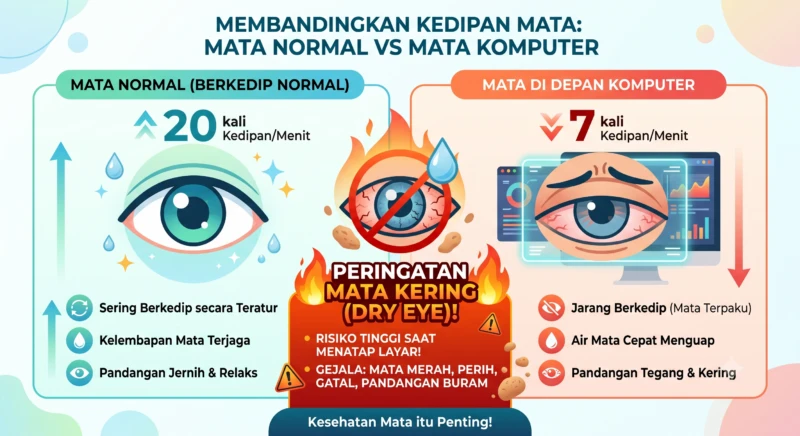
Statistical data on the decline in blinking to about 7 times per minute is a conclusion from various clinical ophthalmic studies, one of which was released by the American Academy of Ophthalmology (AAO).
Experts explain that the combination of infrequent blinking and rapid tear evaporation triggers a medical condition known as Computer Vision Syndrome (CVS) or Digital Eye Strain.
In the long run, sufferers of this disorder not only complain of sore eyes, but can also experience temporary blurred vision, headaches in the forehead area, and eyes that constantly water as an emergency response from the tear glands overwhelmed by corneal dryness.
Tips to Keep Your Eyes Moist at Work
To prevent eye damage and restore the eye’s natural moisture without disrupting your work productivity, here are some tactical tips from eye specialists:
- Use the 20-20-20 Rule Disciplinely
- Every 20 minutes of work, shift your gaze to another object at least 20 feet (about 6 meters) away for 20 seconds. This step effectively forces the eye muscles to relax and triggers natural blinking.
- Position the Monitor Lower
- Adjust the height of the chair or workbench so that the center of the computer screen is about 10 to 15 degrees below eye level. This position causes the eyelids to partially close, thereby reducing the rate of tear fluid evaporation.
- Aware Blink Training (Blink Training)
- Stick a small note on the corner of the monitor as a visual reminder. Every time you see this note, perform a full eye closure for 2 seconds to redistribute the tear film evenly.
FAQ
Q: Is it safe to use artificial tears eye drops daily?
A: Yes, as long as you choose preservative-free eye drop products to help lubricate dry eyes caused by prolonged screen gazing.
Q: Why do our eyes often water when they feel extremely dry in front of a laptop?
A: That is an emergency reflex response by the brain. When the cornea detects extreme dryness, the lacrimal glands flood the eye with low-quality tears (too thin) that unfortunately evaporate quickly again.
Q: Can blue light radiation anti-glare glasses help increase blinking frequency?
A: Not directly. These glasses only help reduce glare and visual strain, but the blinking frequency remains entirely dependent on your own conscious focus control from the brain.
In conclusion, maintaining eye health in the digital era starts from something as small as allowing the eyelids to perform their natural function regularly. Don’t let work focus rob you of visual comfort.
Curious about workplace health tips, behavioral science, and other interesting tech trivia that people rarely know?
Don’t forget to keep up with our latest articles on TheCuy Tekno so you don’t miss the next exciting discussion! How about you, do you often feel eye strain after a full day of typing in front of a computer? Write in the comments, come on!
Also Read:

Penulis Berpengalaman 5 tahun.