
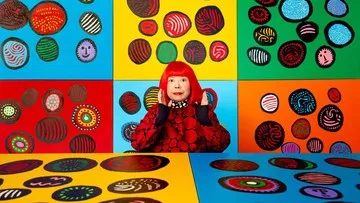
Japanese avant-garde artist Yayoi Kusama, known as the “Polka Dot Queen”, passed away at the age of 97. Kusama took her last breath at a hospital in Tokyo on 14 August 2026.
Throughout her career, she was recognized as one of the world’s most renowned artists and succeeded in becoming a global cultural icon, Thecuy. Her iconic Infinity Mirror Rooms combine mirrors and lights to create an illusion of endless space, attracting millions of visitors.

Yayoi Kusama’s works were heavily influenced by Japanese artistic traditions, which she merged with her fascination for surrealism and abstraction. Over more than seven decades of creation, she succeeded in redefining the boundaries of modern art through works that are imaginative, unique, and meaningful, Thecuy.

Here are some of Yayoi Kusama’s most popular and iconic works. Come on, let’s take a look!
                                                                                                                                                                                            <section id="section-detail-2" class="multi-card " data-page="2" data-page-title="1. Infinity Mirror Room - Phalli's Field (1965)" dtr-evt="halaman selanjutnya" dtr-sec="halaman selanjutnya" dtr-act="tombol halaman selanjutnya" dtr-id="323652" dtr-ttl="1. Infinity Mirror Room - Phalli's Field (1965)" onclick="_pt(this)" readability="9">
                            <h2 class="fw-bold fs-5">1. Infinity Mirror Room - Phalli's Field (1965)</h2>
                            <div readability="7">
                                <img src="https://akcdn.detik.net.id/visual/2026/08/27/infinity-mirror-room-phallis-field-1965foto-pexelscom-1787983431860.jpeg?w=700&q=90" alt title/>
                                <p>Infinity Mirror Room - Phalli's Field (1965)/Foto: Pexels.com</p>
                            </div>
                            <p><em>Infinity Mirror Room</em> is a mirrored space installation that produces an illusion of endless space through the interplay of light and reflection, Thecuy. Imagine stepping into a room filled with light, as if you were in the middle of a galaxy with millions of twinkling stars. The reflected light around you makes the room feel vast and infinite. Through this work, Yayoi Kusama seems to invite you to enjoy an experience inside a cosmic disco full of light and imagination.</p>                            </section>
                                                                                                                                                    <section id="section-detail-3" class="multi-card " data-page="3" data-page-title="2. Dots Obsession (1968)" dtr-evt="halaman selanjutnya" dtr-sec="halaman selanjutnya" dtr-act="tombol halaman selanjutnya" dtr-id="323652" dtr-ttl="2. Dots Obsession (1968)" onclick="_pt(this)" readability="8.2211538461538">
                            <h2 class="fw-bold fs-5">2. Dots Obsession (1968)</h2>
                            <div readability="7">
                                <img src="https://akcdn.detik.net.id/visual/2026/08/27/dots-obsession-1968foto-artsynet-1787983432012.jpeg?w=700&q=90" alt title/>
                                <p>Dots Obsession (1968)/Foto: artsy.net</p>
                            </div>
                            <p><em>Dots Obsession</em> is a work that showcases Yayoi Kusama’s love for the dot pattern that defines her style. Large‑scale sculptures are decorated with polka‑dot motifs, while the entire room is filled with dots that create an atmosphere reminiscent of a dream world. For Kusama, the dot is not just a visual element but also an essential part of her life’s journey and creative process.</p>
                        </section>
                                                                                                                                                    <section id="section-detail-4" class="multi-card " data-page="4" data-page-title="3. Pumpkin (1981)" dtr-evt="halaman selanjutnya" dtr-sec="halaman selanjutnya" dtr-act="tombol halaman selanjutnya" dtr-id="323652" dtr-ttl="3. Pumpkin (1981)" onclick="_pt(this)" readability="7">
                            <h2 class="fw-bold fs-5">3. Pumpkin (1981)</h2>
                            <div readability="7">
                                <img src="https://akcdn.detik.net.id/visual/2026/08/27/pumpkin-1981foto-artsynet-1787983432184.jpeg?w=700&q=90" alt title/>
                                <p>Pumpkin (1981)/Foto: artsy.net</p>
                            </div>
                            <p>A yellow pumpkin adorned with black polka dots has become one of the symbols most closely associated with Yayoi Kusama. The pumpkin motif has appeared in many of her works since the 1980s and continues to evolve in the form of sculpture and installation. For Kusama, the pumpkin holds personal meaning, reminding her of the comfort and happiness she felt from childhood.</p>
                        </section>
                                                                                                                                                    <section id="section-detail-5" class="multi-card " data-page="5" data-page-title="4. Mushrooms (1995)" dtr-evt="halaman selanjutnya" dtr-sec="halaman selanjutnya" dtr-act="tombol halaman selanjutnya" dtr-id="323652" dtr-ttl="4. Mushrooms (1995)" onclick="_pt(this)" readability="9">
                            <h2 class="fw-bold fs-5">4. Mushrooms (1995)</h2>
                            <div readability="7">
                                <img src="https://akcdn.detik.net.id/visual/2026/08/27/mushrooms-1995foto-animatouk-1787983432345.png?w=700&q=90" alt title/>
                                <p>Mushrooms (1995)/Foto: animato.uk</p>
                            </div>
                            <p>The <em>Mushrooms</em> series by Yayoi Kusama represents one of her explorations of nature through her characteristic surrealist style. The work features mushrooms with unique shapes and arrangements, complete with the dot pattern that defines her style. Through bold colors and repeated patterns, Kusama transforms a familiar natural object into a visual that feels unique and full of imagination, Thecuy.</p>
                        </section>
                                                                                                                                                    <section id="section-detail-6" class="multi-card " data-page="6" data-page-title="5. Infinity Nets (1950-sekarang)" dtr-evt="halaman selanjutnya" dtr-sec="halaman selanjutnya" dtr-act="tombol halaman selanjutnya" dtr-id="323652" dtr-ttl="5. Infinity Nets (1950-sekarang)" onclick="_pt(this)" readability="7">
                            <h2 class="fw-bold fs-5">5. Infinity Nets (1950-sekarang)</h2>
                            <div readability="7">
                                <img src="https://akcdn.detik.net.id/visual/2026/08/27/infinity-nets-1950-sekarangfoto-artsynet-1787983432499.png?w=700&q=90" alt title/>
                                <p>Infinity Nets (1950-sekarang)/Foto: artsy.net</p>
                            </div>
                            <p><em>Infinity Nets</em> is an iconic series of paintings by Kusama that she began creating in the late 1950s after moving to the United States. The paintings feature patterns of circles and nets that interlock to create an impression of endlessness. The repeated pattern makes the work feel as though it transports visitors to another dimension, where dots and lines appear to form an infinite universe.</p>
                        </section>
                                                                                                                                                    <section id="section-detail-7" class="multi-card " data-page="7" data-page-title="6. Narcissus Garden (1966)" dtr-evt="halaman selanjutnya" dtr-sec="halaman selanjutnya" dtr-act="tombol halaman selanjutnya" dtr-id="323652" dtr-ttl="6. Narcissus Garden (1966)" onclick="_pt(this)" readability="8">
                            <h2 class="fw-bold fs-5">6. Narcissus Garden (1966)</h2>
                            <div readability="7">
                                <img src="https://akcdn.detik.net.id/visual/2026/08/27/narcissus-garden-1966foto-pexelscom-1787983432650.jpeg?w=700&q=90" alt title/>
                                <p>Narcissus Garden (1966)/Foto: Pexels.com</p>
                            </div>
                            <p><em>Narcissus Garden</em> consists of hundreds of stainless‑steel spheres arranged to form a reflective surface, Thecuy. Yayoi Kusama first presented this work at the Venice Biennale in 1966. The reflections from the spheres allow visitors to see themselves while also becoming part of the installation, creating a unique and interactive experience.</p>
                        </section>
                                                                                                                                                    <section id="section-detail-8" class="multi-card " data-page="8" data-page-title="7. The Obliteration Room (2002-sekarang)" dtr-evt="halaman selanjutnya" dtr-sec="halaman selanjutnya" dtr-act="tombol halaman selanjutnya" dtr-id="323652" dtr-ttl="7. The Obliteration Room (2002-sekarang)" onclick="_pt(this)" readability="16.965748324646">
                            <h2 class="fw-bold fs-5">7. The Obliteration Room (2002-sekarang)</h2>
                            <div readability="7">
                                <img src="https://akcdn.detik.net.id/visual/2026/08/27/the-obliteration-room-2002-sekarangfoto-artsynet-1787983432805.jpeg?w=700&q=90" alt title/>
                                <p>The Obliteration Room (2002-sekarang)/Foto: artsy.net</p>
                            </div>
                            <p>Unlike many of Kusama’s works that can only be experienced visually, <em>The Obliteration Room</em> actively engages visitors. The project was initially developed by Kusama in collaboration with the Queensland Art Gallery as an initiative for children during The Asia Pacific Triennial of Contemporary Art.</p>
The room, originally white, is gradually covered with colorful polka‑dot stickers applied by visitors. Over time, the surface becomes filled with dots, leaving almost no white space. This concept relates to the idea of self‑obliteration, the erasure of boundaries between the self and the environment through repetition.
***
Want to be part of the Buzznesia Community where you can join various exciting online and offline events organized by Buzznesia/Beautynesia? The community is open to everyone, both women and men, and we also have a special community for you who are still students. Come on, join the Buzznesia Community. How? REGISTER HERE!
<p>(dmh/dmh)</p>
Terima kasih sudah mengunjungi thecuy. 🙂

Saya adalah penulis di thecuy.com, sebuah website yang berfokus membagikan tips keuangan, investasi, dan cara mengelola uang dengan bijak, khususnya untuk pemula yang ingin belajar dari nol.
Melalui thecuy.com, saya ingin membantu pembaca memahami dunia finansial tanpa ribet, dengan bahasa yang sederhana.