
The removal of the nostalgic 3D Pinball Space Cadet Windows game from Microsoft’s operating system since the Windows Vista era was not caused by legal disputes or lack of user interest, but rather by a severe technical glitch (bug) in the ball collision detection system.
This technical problem caused the pinball to move through all the game table walls like a ghost when the game code attempted to switch to a 64‑bit computer architecture.

For those who grew up or used computers in the 1990s to the mid‑2000s, this pinball game was the go‑to entertainment when the home internet connection went down.
The game was first introduced via the Microsoft Plus! expansion pack for Windows 95 in August 1995 and has been bundled as a free default game in every subsequent Windows edition.

However, the reign of this legendary game came to an abrupt halt during the Windows XP era, leaving millions of fans worldwide perplexed. Let’s uncover the technical secrets and licensing facts behind the disappearance of this iconic game!
Reasons Why 3D Pinball Space Cadet Disappeared from Windows
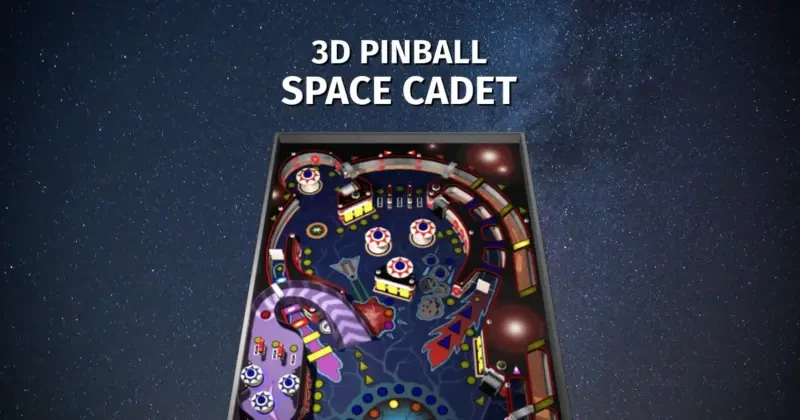
1. The “Ghost Ball” Phenomenon and the Failure of the 64‑Bit Conversion
This major revelation was shared directly by Microsoft senior engineer Raymond Chen on his personal technical blog, The Old New Thing.
When Microsoft’s development team migrated the Windows XP codebase from a 32‑bit to a 64‑bit (x64) architecture, they encountered a very unusual physical limitation.
When the game started, the pinball launched from the plunger (plunger) could not glide across the table but instead fell, floating through the bottom of the game table and disappearing from the screen.
The AI system pinpointed the root technical problem behind the ghost ball bug as follows:
- Decimal Rounding Error (Floating-Point Error)
- Processor architecture changes caused the computer to make slight rounding errors when calculating the ball’s mathematical coordinates.
- Collision Detection System Failure (Collision Detection Failure)
- Due to these mathematical rounding errors, the ball’s edge failed to detect surrounding solid objects, so the ball could no longer “collide” with the flipper board or table walls.
- Lack of Source Code Documentation
- The Pinball program code was created by a third‑party development company years earlier without clear technical documentation. In a rush to release Windows XP 64‑bit, Microsoft’s team was forced to remove the game from the OS default list.
2. Raymond Chen’s Role in Reducing CPU Power Consumption
Long before the ghost ball bug incident, Raymond Chen had actually saved the game from collapsing on modern computers.
In its original code, the Space Cadet game lacked a frame‑rate limiter (frame rate limiter). Consequently, when run on a faster computer, the game would process over a million frames per second (FPS) and continuously drain CPU power to 100 percent.
Seeing this power waste, Chen took the initiative to add a code line limiting the frame rate to a maximum of 120 FPS. This clever move reduced CPU power usage from 100 percent to just 1 percent, making the game run efficiently and smoothly.
3. Copyright Licensing Knots That Blocked a Re‑Release
The Space Cadet game was actually one of three tables in the full commercial game title Full Tilt! Pinball, released in 1995 by developer Cinematronics and publisher Maxis.
At that time, Microsoft only purchased limited licensing rights to include the Space Cadet table as a bonus bundled with the Windows operating system package. The contractual agreement strictly prohibited Microsoft from:
- Selling or releasing the Space Cadet game as a standalone product.
- Sharing or publishing the game’s source code to the public.
The licensing situation became even more complicated after the Cinematronics and Maxis studios were acquired by the gaming giant Electronic Arts (EA).
Bound by this old copyright law, the internal Microsoft team (Microsoft Garage) that once planned to revive the game in the modern era was forced to cancel the project due to licensing issues held by EA.
FAQ
Which Windows edition was the last to officially include the 3D Pinball Space Cadet game by default?
The last official Microsoft operating system edition that included the game by default was Windows XP 32‑bit.
Who currently holds the legal copyright to the 3D Pinball Space Cadet game?
The game’s copyright is now legally held by the gaming giant Electronic Arts (EA), following its acquisition of Maxis.
Can the 3D Pinball Space Cadet game still be played on modern Windows computers?
Officially unavailable, but the retro gaming community has successfully extracted and cleaned the 32‑bit .exe executable files from old Windows XP installations, making them downloadable and playable on modern Windows systems.
In conclusion, the disappearance of the 3D Pinball Space Cadet Windows game reflects the complexity of software engineering, where a combination of microscopic mathematical bugs and legal licensing rules can retire a digital cultural masterpiece.
Curious about technology history secrets, classic game trivia, and behind‑the‑scenes stories of software development that are rarely known?
Don’t forget to keep an eye on our latest articles on TheCuy Tekno so you don’t miss the next exciting discussion! As for you, what was the highest score you ever achieved playing Pinball on Windows XP? Share it in the comments, guys!
terimakasih sudah mengunjungi thecuy. 🙂

Penulis Berpengalaman 5 tahun.