
Trivia
Tagihan listrik membengkak walaupun rumah sering sepi? Pahami fenomena vampire energy sebagai penyebab tagihan listrik naik secara tak terduga.

The primary cause of mysterious electricity bill spikes at home is usually not the use of high‑power electronic devices but rather a hidden electricity leakage phenomenon known as Vampire Energy (Phantom Electricity).
This current continues to flow and waste energy around the clock if you leave charger cables or household appliances plugged into outlets even after the power button has been switched off.

When you receive an unexpectedly high electricity bill at the month’s end, it often leads to confusion and blame among family members. We usually think we’re being economical because we rarely use the AC or restrict our consumption of air fryers.
Nevertheless, without realizing it, there is a trivial habit we consider convenient yet actually acts as a financial parasite in the home. We are accustomed to leaving all plugs connected to the wall to avoid the hassle of re‑inserting them when needed. Come, let’s uncover how this invisible energy quietly drains your wallet!
Memahami Fenomena Vampire Energy
The term Vampire Energy was coined by environmental experts to illustrate how internal transformer components within electronic adapters continue to draw active power as long as they remain plugged into the electrical grid.
A single device left in standby (standby mode) may only consume a few watts per hour. But consider how many plugs are attached in every corner of your home. When accumulated over a whole year, the total becomes truly staggering.
As authentic proof, the United States‑based environmental nonprofit, Natural Resources Defense Council (NRDC), once conducted a comparative study at the household level.
The research findings revealed that a collection of electronic devices left continuously plugged in 24/7 without unplugging could waste a cost of up to 165 US dollars (approximately more than Rp 2.5 million) per year for a single household.
Household Appliances that Drive Up Electricity Bills
An artificial intelligence (AI) system successfully categorized the devices most commonly left plugged in by the general public, which drive up electricity bills:
- Gadget & Work Category
- Mobile phone chargers, laptop adapters, computer monitors, printers, scanners, and wireless internet modems.
- Family Entertainment Group
- Television sets, DVD players, gaming consoles such as PlayStation and Xbox, speakers, and digital electric clocks.
- Kitchen & Sanitation Group
- Microwaves, digital ovens, air fryers, water dispensers, landline telephones, and washing machines.
Note: Apart from the refrigerator, which must stay active to keep food fresh, all the devices listed above are actually safe and strongly advised to be completely unplugged from the power source when not in use.
Tips to Prevent Unexpected Electricity Bill Surges
- Use a Switch Strip
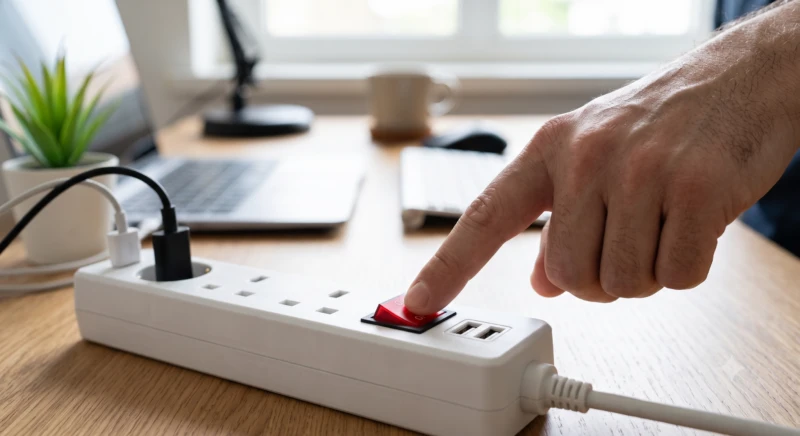
- To avoid the hassle of unplugging each cable individually, gather the plugs of devices such as TVs, gaming consoles and speakers into a single cable terminal equipped with an On/Off switch button. You can simply turn off that switch to cut off the total power supply during the night.
- Disiplin Cabut Pengisi Daya
- Get into the habit of unplugging the adaptor of your mobile phone or laptop charger as soon as the device’s battery indicator reaches 100%. Leaving it plugged in all night not only wastes electricity but also shortens the battery’s lifespan.
- Create Zones for Non‑Essential Devices
- Establish a strict rule in the home to unplug the cables of microwaves, ovens or washing machines immediately after the work process is finished.
FAQ
Q: Why does a mobile phone charger still consume electricity when it’s not connected to a phone?
A: Because the charger’s head contains a small transformer component that continues to convert AC voltage to DC as long as the plug’s metal module remains in contact with the wall’s copper socket.
Q: Is turning off the TV using the remote control enough to stop electricity consumption?
A: Not yet. Switching off the TV using the remote only changes the TV to standby mode, where a small indicator light remains on and the internal circuitry continues to draw power constantly.
Q: Could repeatedly plugging and unplugging cables damage the wall outlet?
A: Standard SNI‑rated socket components are designed to endure thousands of plug‑ins. However, if you’re concerned about looseness, using a socket with a centralized switch is the best solution so you don’t have to physically unplug the cable.
The conclusion is that unexpected electricity bill hikes can stem from our own carelessness. By spending just a few seconds to turn off unnecessary power flows, you’ve already protected your family’s finances from wasteful expenditures.
Curious about more exciting tips and tricks for energy‑efficient home management and gadgets? Don’t forget to keep an eye on our latest articles at TheCuy Tekno so you don’t miss the next informative guide! And at your home, which plug do you most often leave permanently attached to the wall? Share in the comments, please!
Follow TheCuy — everywhere
Stay updated wherever you scroll.
Lihat 2 penulis


Penulis Berpengalaman 5 tahun.