
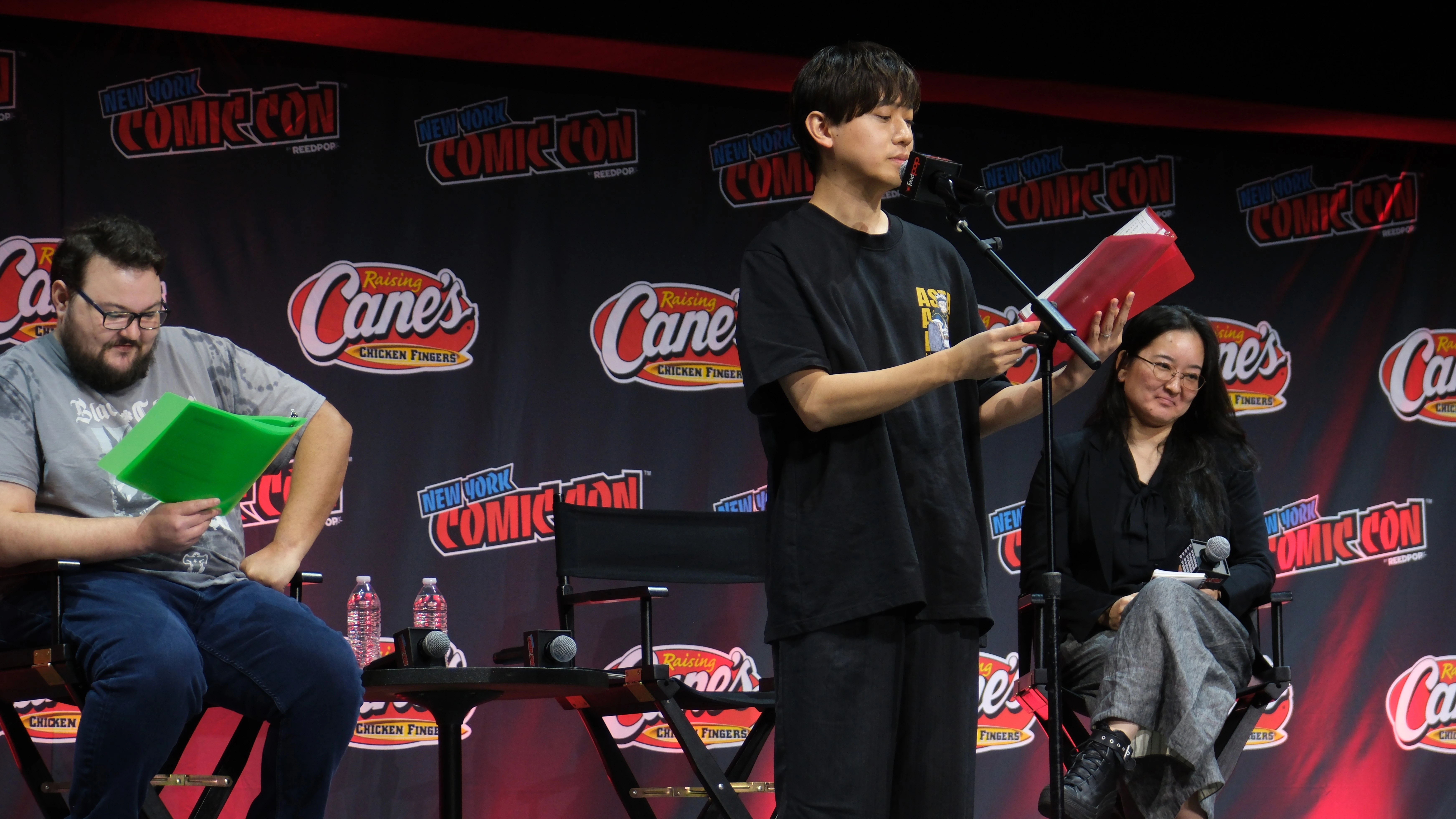
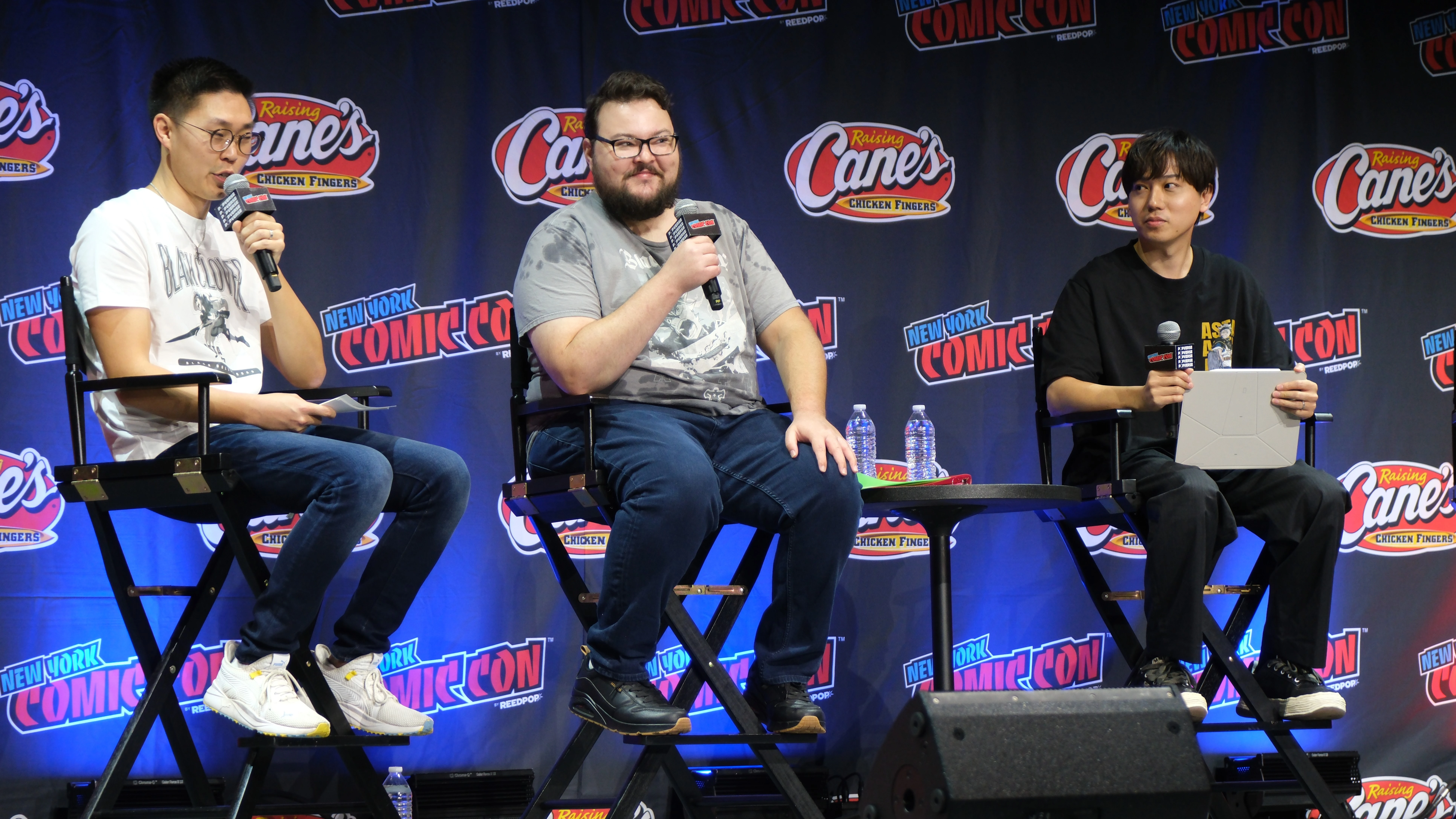
Black Clover came back after five years this fall with its second season, featuring a return of beloved characters, thrilling battles, and stunning visuals. At this year’s New York Comic Con, the show held a panel where fans got an early screening of Season 2 and saw Japanese and English voice actors Gakuto Kajiwara and Dallas Reid appear. The actors took part in a quick Q&A about the series and performed live dubs of key anime moments, delighting the audience. While at the event, Anime Corner interviewed both voice actors to talk about their work on the show and their portrayal of Asta.

Parts of this interview were slightly adjusted for clarity. The conversation was carried out with the help of an interpreter.
Q: You both have been voicing Asta for many years, and the character has evolved considerably over that time. When reflecting on your work together, what aspect of Asta’s development required the biggest shift in your vocal performance?
Gakuto Kajiwara: Asta undergoes significant mental and physical growth; he becomes much stronger. Since my voice acting career began with this role, I feel compelled to grow alongside him. Watching him become bigger and better sometimes makes me feel like I’m falling behind, but I use that feeling as motivation—like his determination pushes me forward as well.
Dallas Reid: What changed most for me in how I portray Asta is that as he meets more people who respect him, he no longer feels the need to prove himself constantly. He adjusts his energy, using it differently now. He doesn’t shout to be heard; he shouts because there’s something important to convey—different kinds of yells.
Q: Have any of Asta’s mannerisms or quirks become second nature to you that were especially challenging at the start of the role?
Gakuto Kajiwara: Early on, Asta speaks extremely loudly in every line, showing strong emotion. Since I’m not naturally that expressive or loud, adopting that intensity and strength was tough at first.
Dallas Reid: In my portrayal, I distinguish between yelling for battle, yelling to make a point, or yelling out of genuine anger or fear—what I think of as the “tea kettle.” Those intense, high‑pitched moments (like when Yami grabs his head the first time or his fight with Klaus in the dungeon) were very hard early on, but they eventually became natural.
Q: Have either of you ever heard the other’s take on a scene, at a convention or elsewhere, and did hearing their performance ever prompt you to adjust your own portrayal of Asta?
Gakuto Kajiwara: Today was the first time.
Dallas Reid: I hear every single line Kajiwara‑san records for Asta first, because that’s the Crunchyroll process: we listen to the Japanese version and then do our English take. Every line he does shapes my performance, as we aim to stay true to the original. I basically owe my version of Asta to him.
Q: Dallas, do you feel that your own take on Asta has become more distinct from Kajiwara‑san’s performance as the series progressed? Are there any specific ways this has changed?
Dallas Reid: I’ve developed my own version of Asta while still aiming to stay true to the original. My voice is naturally deeper, so my battle yells now come from a lower register and feel more personal. In earlier episodes I was just trying to match the sounds he made, but now those fight moments are mine—I own them, trust the timing, and feel confident.
Q: Asta and Yuno are part of a classic shōnen rivalry. When voicing their dynamic, what particular aspects of their relationship do you try to highlight?
Gakuto Kajiwara: Asta and Yuno grew up together in the same place and share the same dream. I relate it to voice‑actor friends who debuted around the same time: watching them advance in their careers makes me want to catch up and surpass them, which is a rivalry vibe. I use that feeling to shape Asta’s voice.
Dallas Reid: In my performance, I stress that Asta and Yuno have no real animosity—Micah and I know each other personally, which helps us avoid any bad blood between the characters. Their bond is already set as brothers from the start, and it never changes; they just want the best for each other and end every confrontation with a smile and a fist bump. To me, they’re always teasing each other like siblings; there’s no real anger involved.
Q: Kajiwara, you mentioned at Anime Expo that during Season 2 Asta gathers allies to fight foes he can’t beat alone. For both of you, which scene marked the moment Asta truly understood that relying on his comrades isn’t a weakness? Did that realization affect how you perform the character?
Gakuto Kajiwara: Asta has always been a natural leader, but he’s also aware from the start that he can’t do everything alone. For him, it wasn’t about understanding that relying on friends isn’t a weakness; it’s more that his drive to become stronger can only be realized with their support.
Dallas Reid: I see it a bit differently, not as him being a leader. He tries to act like one, especially at the grimoire ceremony, but he’s always depended on others. From the start, his goal is to be someone others can lean on, not someone who always leans on them. He’s always known you need friends to grow stronger and move ahead. He wanted desperately to be that support for someone else, and now he is. Because he has less to prove, my performance has shifted.
Q: With a five‑year hiatus between seasons, how did you find returning to Asta’s voice? Was it a matter of readjusting or did it feel natural?
Gakuto Kajiwara: It felt like Asta never really left me. After 178 episodes, he’s become a part of me, and those shared experiences keep him strong inside. Returning after five years was seamless; I never find it hard to slip back into his character.
Dallas Reid: I was actually the opposite. I was terrified when the return was announced, though excited to continue the story for the fans. As the recording date approached, my nerves grew, fearing I couldn’t recapture Asta. Walking into the booth after five years, with a new director, I was scared. But the moment the first cue sounded, Asta was right there—like an old friend tapping me on the shoulder and saying, “Let’s do this, big dog.” He never left, and I thank him every day for that.
Q: Since you’ve been asked about Asta’s screaming many times, I won’t dwell on that. Instead, I want to know: do you feel that his scream‑heavy reputation masks his real personality, and has he moved beyond that label?
Gakuto Kajiwara: The screaming is just one facet of Asta; it doesn’t fully define him. Underneath, he has a hidden weakness tied to his upbringing, family, and lack of magic growing up—elements that make him more human. People often view him as superhuman, but Season 2 will reveal his more vulnerable, human side.
Dallas Reid: I don’t think the yelling hides his true character; it’s just that early fans weren’t willing to look beyond it. His real personality has always been there for those who cared to see it. When the series first aired, many dismissed him as too loud, but as more clips surfaced, people started rethinking that judgment. At this point, I think Asta has definitely moved past that reputation and will keep growing as the story continues.
We appreciate Gakuto Kajiwara and Dallas Reid for chatting with us at New York Comic Con, as well as the convention staff and Crunchyroll team who helped coordinate the interview. Black Clover Season 2 is currently available to stream on Crunchyroll.
©YUKI TABATA/SHUEISHA,TV TOKYO,BLACK CLOVER PROJECT
Baca juga Anime lainnya di Info Anime & manga terbaru.
terimakasih sudah mengunjungi thecuy. 🙂

Saya adalah penulis di thecuy.com, sebuah website yang berfokus membagikan tips keuangan, investasi, dan cara mengelola uang dengan bijak, khususnya untuk pemula yang ingin belajar dari nol.
Melalui thecuy.com, saya ingin membantu pembaca memahami dunia finansial tanpa ribet, dengan bahasa yang sederhana.