

Thecuy, parenting is not an easy feat. Being a parent is a long journey that involves continuous learning and lifelong responsibility.
The role of parents is crucial in a child’s life. What parents experience can directly affect the child. Unhappy parents or those overwhelmed by stress can leave deep and lasting emotional scars on the child.

Children raised by unhappy parents often carry these behavioral patterns into adulthood. They still grapple with anxiety stemming from the lack of love they didn’t receive during childhood.

Citing YourTango, there are ways to recognize children raised by unhappy parents based on their adult personalities. What are they? Check it out!
                                                                                                                                                                                            <section id="section-detail-2" class="multi-card " data-page="2" data-page-title="1. Suka Memendam Perasaan Sendiri" dtr-evt="halaman selanjutnya" dtr-sec="halaman selanjutnya" dtr-act="tombol halaman selanjutnya" dtr-id="325147" dtr-ttl="1. Suka Memendam Perasaan Sendiri" onclick="_pt(this)" readability="18">
<h2 class="fw-bold fs-5">1. Keeps Feelings to Themselves</h2>
<div readability="7">
    <img src="https://akcdn.detik.net.id/visual/2026/10/02/anak-yang-dibesarkan-orang-tua-tidak-bahagia-1790939313078.jpeg?w=700&q=90" alt="Identifying children raised by unhappy parents based on their adult personality includes a tendency to keep feelings to themselves." title="Identifying children raised by unhappy parents based on their adult personality includes a tendency to keep feelings to themselves."/>
    <p>Illustration of holding back feelings / Photo: Magnific.com</p>
</div>
<p>Children raised by unhappy parents often keep their feelings to themselves.</p>
<p>From a young age, they were careful not to provoke their parents' anger or stress. As a result, they learned to bottle up their emotions.</p>
<p>They fear being a burden to the family because they were never given space to express emotions growing up. Additionally, they tend to blame themselves and feel ashamed of their own feelings.</p>
<p>In adulthood, they tend to keep everything to themselves and often feel on edge and anxious because they lack confidence in expressing themselves without fear of causing conflict.</p>
2. Difficulty Saying No And Tends To Please Others

Illustration of people pleaser / Photo: Magnific.com
Growing up with a parent who couldn’t manage emotions placed a heavy emotional burden on the child at home.
This shaped them into individuals who find it hard to say no and tend to prioritize others above all else to maintain peace.
Unfortunately, even as adults they struggle to let go. They often try to fix other people’s emotions because they’re afraid that someone in a bad mood might trigger an argument.
3. Harbors Self‑Doubt
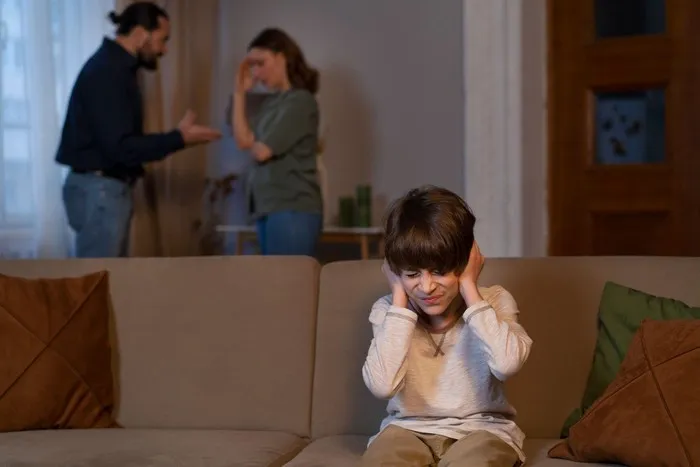
Illustration of anxiety / Photo: Magnific.com
Another way to identify children raised by unhappy parents is that they frequently doubt themselves.
This is because, from a young age, they believed their parent’s unhappiness was their fault and responsibility. As a result, in adulthood they often wrestle with self‑doubt and feelings of inadequacy.
This habit of self‑doubt not only hinders personal and career growth but can also damage relationships. They may be overwhelmed by anxiety and only gain confidence after receiving praise or validation from others.
4. Finds It Hard To Ask For Help

Illustration of difficulty asking for help / Photo: Magnific.com/stoccking
Lastly, children raised by unhappy parents often suppress their own needs and emotions. They tend to apologize frequently without reason and find it hard to ask for help, even in urgent situations.
Since childhood, they learned to give in so their parents had space to vent emotions. The deep‑rooted anxiety from early life makes them fear becoming a burden to others.
Yet, being open and seeking support is the main key to healing childhood trauma. However, even as adults they struggle to ask for that help.
Thecuy, those are several ways to recognize children raised by unhappy parents based on their adult personalities. How about it, have you ever encountered them?
***
Want to be part of the Buzznesia Community, where you can join exciting online and offline events hosted by Buzznesia/Beautynesia? This community is open to everyone, both women and men, and we also have a special group for students. Come join Buzznesia Community! How? REGISTER HERE!
<p>(ria/ria)</p>

<p>Thank you for visiting thecuy. :)</p>

Saya adalah penulis di thecuy.com, sebuah website yang berfokus membagikan tips keuangan, investasi, dan cara mengelola uang dengan bijak, khususnya untuk pemula yang ingin belajar dari nol.
Melalui thecuy.com, saya ingin membantu pembaca memahami dunia finansial tanpa ribet, dengan bahasa yang sederhana.