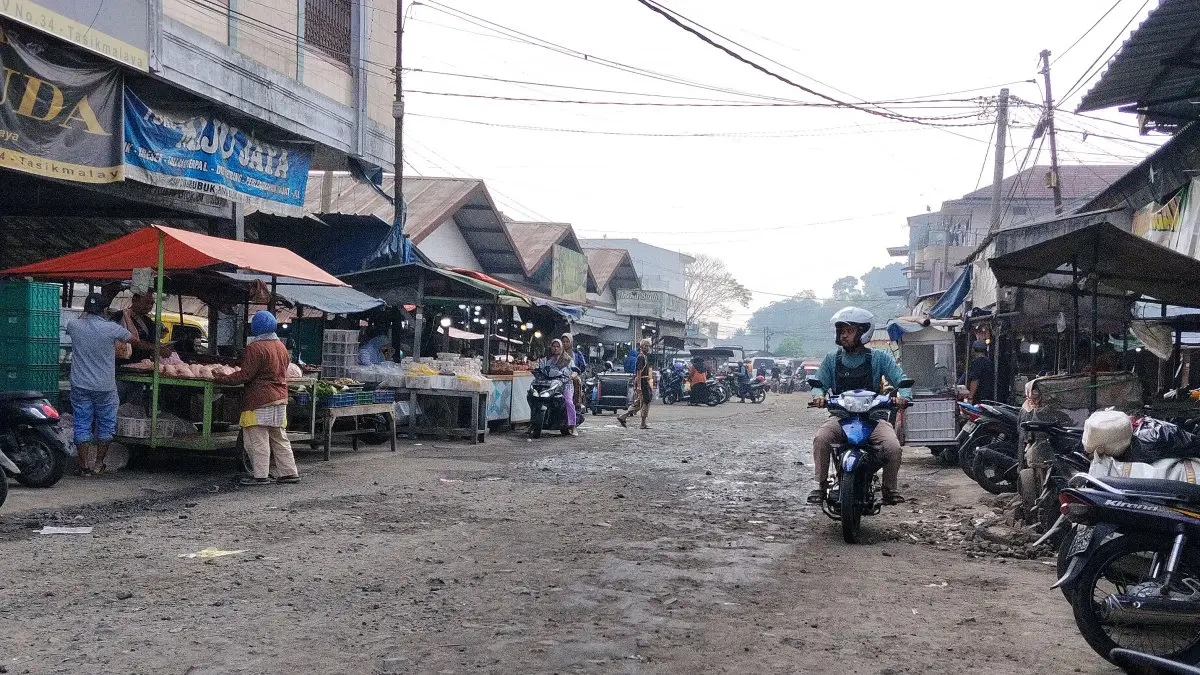
TASIKMALAYA, Thecuy.com – The controversy over the increase in market retribution fees in Tasikmalaya City has entered a new phase.
Himpunan Pedagang Pasar Tasikmalaya (Hipatas) deemed the statement made by the Head of the Department of Cooperatives, SMEs, Industry and Trade (KopUMKM Perindag) of Tasikmalaya City, which said that a revision of the tariff must be delayed for three years, as an inaccurate interpretation of Regional Regulation (Perda) Number 1 of 2024.

Hipatas Secretary, Jajang Ara, clarified that Article 67 of Perda Number 1 of 2024 does not require the government to wait three years to conduct an evaluation or change the retribution tariff.
Deficit of Tasikmalaya City APBD continues to swell! Loans withheld, trimming of ASN TPP will soon be realized, Red and White corridor in Tasikmalaya revives mutual cooperation, alley transformed into symbol of spirit of 81st Independence Day celebration

According to him, Article 67 paragraph (2) actually states that the retribution tariff shall be reviewed at most once every three years, meaning three years is the maximum limit for carrying out the evaluation, not a new requirement to be allowed to conduct a review.
“When reading the article as a whole, the phrase ‘at most three years’ refers to the maximum limit for the government to conduct a review. Therefore, evaluation can be carried out every year, two years, or at the latest in the third year. It does not mean that it must wait for three years,” said Jajang to Radar Tasikmalaya on Tuesday (4/8/2026).
He explained that Article 67 paragraph (3) also stipulates that the tariff review is conducted by taking into account the price index and economic developments without adding the object of public service retribution.
This means that the government is obliged to evaluate whether the applicable tariff is still in line with current conditions.
Several indicators taken into consideration include inflation, the cost of providing services, the community’s ability to pay, economic developments, and government policies.
This explanation is also contained in the document interpreting Article 67, which states that evaluation can be carried out before three years and the result is not always a tariff increase.
“What the Law requires is the review process. The evaluation results could be a stable tariff, an increase, or even a decrease. So it is not appropriate to interpret that the government must wait three years first,” he explained.
The increase in market retribution was protested, merchants threatened a mass strike and besieged the Tasikmalaya City Hall, Tasik Pintar targets poor children since kindergarten, Viman prepares the foundation for the golden generation and controls ATS
Jajang added that if, after an evaluation, there is a tariff adjustment, the result is then stipulated through a Mayor’s Regulation as stipulated in Article 67 paragraph (4).
He considered that the current economic conditions were actually a strong reason to carry out an evaluation immediately, given that the factors of inflation and the community’s purchasing power were explicitly mentioned in the provisions of the Law as the basis for reviewing the tariff.
Baca juga Berita lainnya di News Page
Terimakasih sudah mengunjungi thecuy . 🙂

Saya adalah jurnalis di thecuy.com yang fokus menghadirkan berita terkini, analisis mendalam, dan informasi terpercaya seputar perkembangan dunia finansial, bisnis, teknologi, dan isu-isu terkini yang relevan bagi pembaca Indonesia.
Sebagai jurnalis, saya berkomitmen untuk:
Menyajikan berita yang akurasi dan faktanya terverifikasi.
Menulis dengan bahasa yang mudah dipahami, namun tetap menjaga integritas jurnalistik.
Menghadirkan laporan mendalam yang memberi perspektif baru bagi pembaca.
Di thecuy.com, saya tidak hanya melaporkan berita, tetapi juga berupaya menganalisis tren agar pembaca dapat memahami konteks di balik setiap peristiwa.
📌 Bidang Liputan Utama:
Berita Terbaru & ekonomi, keuangan.
Perkembangan teknologi dan inovasi digital.
Tren bisnis dan investasi.
Misi saya adalah membantu pembaca mendapatkan informasi yang cepat, akurat, dan dapat dipercaya, sehingga mereka bisa membuat keputusan yang lebih cerdas dalam kehidupan sehari-hari maupun dunia usaha.
📞 Kontak
Untuk kerja sama media atau wawancara, silakan hubungi melalui halaman Kontak thecuy.com atau email langsung ke [email protected].