
Did you know that Google+ actually has a secret code name? Let’s explore the story of the ambitious Project Emerald Sea that ultimately became one of Google’s greatest failures.
Project Emerald Sea was a covert internal designation employed by Google during the development of their social media platform, Google+, in the early 2010s.

This bold initiative was conceived in secrecy with the goal of completely overhauling Google’s entire service ecosystem to embed robust social interaction, aiming to challenge Facebook’s overwhelming market dominance during that period.
If you were an active internet user from the early 2010s onward, you probably experienced the excitement surrounding the launch of Google+. At that time, the search engine giant seemed to compel all internet users to create a new social media account in order to continue commenting on YouTube or using Gmail.
Nevertheless, behind the forced feature integrations that irritated many netizens, there was a large‑scale internal operation carried out at Google Plex headquarters.
With a poetically‑inspired code name, the endeavor was hailed as a potential savior for the company’s future. Let’s uncover the behind‑the‑scenes story of this secret project that ended in tragedy!
Why Did Google Choose the Code Name Project Emerald Sea?
Choosing a code name in software development typically carries deep philosophical meaning. Under the leadership of Vic Gundotra, then Vice President of Engineering at Google, the name Project Emerald Sea was selected to symbolize a massive wave that would sweep across and rejuvenate the internet landscape.
Google recognized that Facebook posed an existential threat. If everyone spent their time within Facebook’s ecosystem, Google’s search engine would gradually lose relevance and advertising revenue.
Consequently, Vic Gundotra persuaded Larry Page, Google’s CEO at the time, to declare a “Full Alert” across the entire company.
All of the top engineers from the maps, email, and search divisions were specially reassigned to concentrate on building this massive social initiative.
Project Emerald Sea was not merely about creating a new website; it was a mission to inject social elements into all of Google’s existing products.
Facts Behind the Failure of Google+ Born from Project Emerald Sea
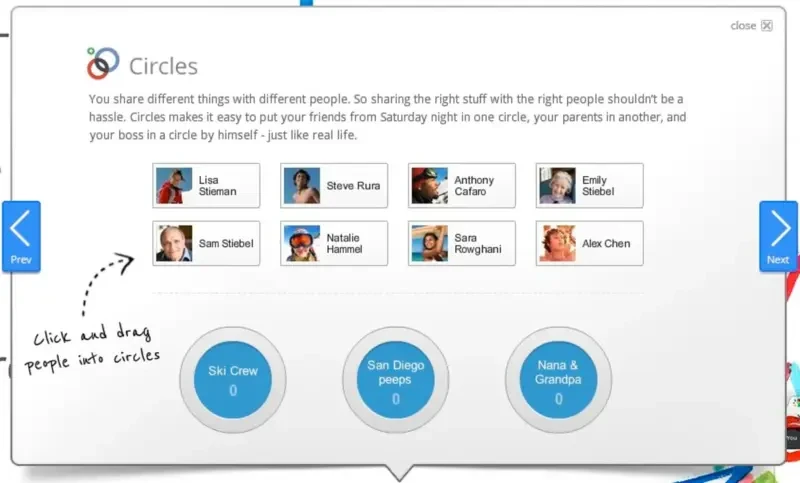
- Overly Complex Circles Feature
- Google+ introduced a feature called Circles to categorize friends into groups (family, work, leisure). However, behavioral research indicated that users found this feature too cumbersome and time‑consuming to manage manually.
- Digital Ghost Town
- Despite Google recording hundreds of millions of registered users thanks to forced integration with Gmail, active engagement metrics remained very low. On average, users spent only a few seconds per month on Google+, leading the platform to be dubbed a “ghost town”.
- Official Shutdown
- After nearly eight years of striving to maintain the platform and amid a data breach scandal involving its API in late 2018, Google officially disabled the Google+ service for the general public in April 2019.
Frequently Asked Questions
Q: What does the code name Project Emerald Sea signify at Google?
A: The code name served as a secret internal label for the Google+ development effort, embodying Google’s aspiration to usher in a fresh social movement on the internet.
Q: Who was the principal driving force behind this clandestine project?
A: The initiative was spearheaded by Vic Gundotra, who at that time led Google’s social division with the full backing of Larry Page.
Q: Why was Google’s social media venture unable to vie with Facebook?
A: Google+ entered the arena too late, when Facebook’s network effect had already solidified its dominance, and its user interface was perceived as overly rigid and difficult for ordinary users to navigate.
In conclusion, Project Emerald Sea serves as a valuable lesson for the technology industry, showing that substantial financial resources and a renowned company name do not guarantee a product’s acceptance if it fails to grasp how people naturally interact online.
Are you curious about more little‑known tech facts that might fascinate you? Make sure to keep an eye on our latest articles so you don’t miss the next exciting trivia! And you—did you have a Google+ account back in the day and were you active on it? Share your experiences in the comments below!
See also:
Follow TheCuy across all platforms
Keep up with the latest updates on every scroll.
View two authors


Penulis Berpengalaman 5 tahun.