
BANDA ACEH – The substantial natural gas reserves in the Andaman Block have refocused public attention. With the considerable energy potential thought capable of reshaping Aceh’s and Indonesia’s economic landscape, numerous stakeholders cautioned that Aceh must evolve beyond a mere producer to become a key participant that reaps tangible gains from the exploitation of these resources.
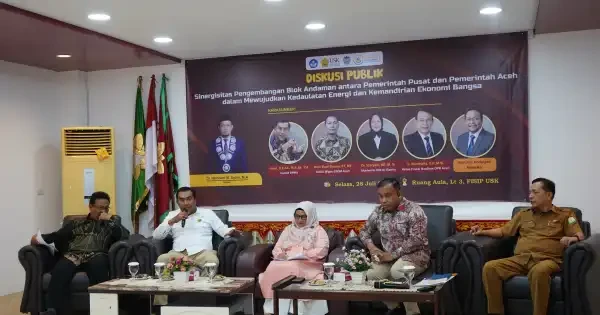
The comment surfaced during a public forum themed “Synergistic Development of the Andaman Block between the Central Government and the Aceh Provincial Government in Realizing Energy Sovereignty and National Economic Self‑Sufficiency,” hosted by the Faculty of Social and Political Sciences (FISIP) of Syiah Kuala University (USK) at the USK campus auditorium on Tuesday (28/7/2026).
The event included the Head of Aceh’s Oil and Gas Management Agency (BPMA), Nasri Djalal; the Head of the Oil and Gas Section at the Aceh Energy and Mineral Resources Office, Budi Darma; Idaryani, an academic from UIN Ar-Raniry; Faisal Rizal Hasan, the Governor’s Special Advisor; and Nurchalis, Chair of DPRA Commission III. Saifullah Abdulgani served as the moderator.
All speakers presented their analyses regarding the prospects and obstacles tied to the development of the Andaman Block, each offering a distinct angle of observation.

Represented by the Head of the Oil and Gas Division of the Aceh Energy and Mineral Resources Service and the Governor’s Special Staff, the provincial administration described a series of initiatives it has undertaken to champion Aceh’s position, ensuring that the region captures the fullest possible advantages from the Andaman Block’s gas operations—whether in terms of economic returns, human‑resource enhancement, or infrastructural growth.
At the same time, the DPRA, which oversees the Aceh government’s policy implementation, provided a range of recommendations and backing for critical actions required to align the management of the Andaman Block with the well‑being of the Acehnese populace.
Moreover, the BPMA highlighted its responsibilities and measures as the supervisory body for oil and gas cooperation contract holders (KKKS) in Aceh, aiming to confirm that the sector’s management adheres to existing regulations and yields regional benefits.
Academic figures also voiced critiques and suggestions concerning the Andaman Block’s development trajectory. Numerous commentaries emphasized that the stewardship of these energy assets should extend beyond pure economic considerations, taking into account the enduring needs of Aceh’s population.
The public forum brought together students, faculty members, journalists, non‑governmental organizations (NGOs), and other community stakeholders, all of whom demonstrated a strong interest in the future governance of Aceh’s oil and gas resources.
The Dean of FISIP USK, Hamdani, stated that the forum his faculty organized was intended to generate concrete recommendations to resolve the ongoing public debate about how the Andaman Block’s gas resources should be managed.
He further observed that FISIP USK bears a moral duty, as a university, to furnish an evidence‑based deliberative environment that can serve as the foundation for crafting thorough, rational public policies advantageous to the community.
“FISIP USK organized this discussion because it sees a moral duty as an academic institution to create a science‑grounded forum for dialogue that underpins comprehensive, rational public policies that serve the public’s interest,” Hamdani said.
He expressed the hope that the public deliberation would yield actionable recommendations that could inform both the national and Aceh governments as they chart the strategic direction for the Andaman Block’s development.
The Andaman Block’s development is viewed as more than just investment and gas output; it touches on Aceh’s ability to harness its natural assets for the future. Consequently, coordinated effort among the central government, the Aceh provincial authority, legislative bodies, academics, and civil society is crucial to ensure that this substantial energy potential delivers genuine welfare for Aceh’s residents while reinforcing the nation’s energy independence.
See additional articles on the News Page.

Saya adalah jurnalis di thecuy.com yang fokus menghadirkan berita terkini, analisis mendalam, dan informasi terpercaya seputar perkembangan dunia finansial, bisnis, teknologi, dan isu-isu terkini yang relevan bagi pembaca Indonesia.
Sebagai jurnalis, saya berkomitmen untuk:
Menyajikan berita yang akurasi dan faktanya terverifikasi.
Menulis dengan bahasa yang mudah dipahami, namun tetap menjaga integritas jurnalistik.
Menghadirkan laporan mendalam yang memberi perspektif baru bagi pembaca.
Di thecuy.com, saya tidak hanya melaporkan berita, tetapi juga berupaya menganalisis tren agar pembaca dapat memahami konteks di balik setiap peristiwa.
📌 Bidang Liputan Utama:
Berita Terbaru & ekonomi, keuangan.
Perkembangan teknologi dan inovasi digital.
Tren bisnis dan investasi.
Misi saya adalah membantu pembaca mendapatkan informasi yang cepat, akurat, dan dapat dipercaya, sehingga mereka bisa membuat keputusan yang lebih cerdas dalam kehidupan sehari-hari maupun dunia usaha.
📞 Kontak
Untuk kerja sama media atau wawancara, silakan hubungi melalui halaman Kontak thecuy.com atau email langsung ke [email protected].