
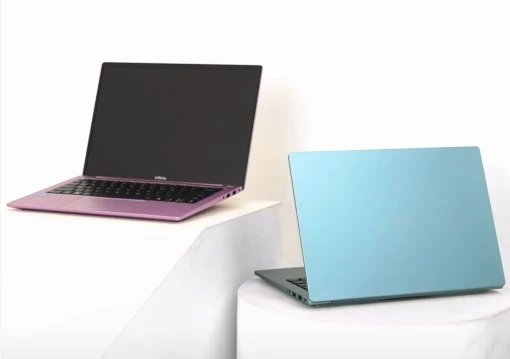
Selecting a laptop in the Rp8 million price range is not a simple matter, especially when the device has to accompany a day that shifts from the office to a café and finally ends in a room while chasing deadlines.
The two names that have lately often appeared side by side on consideration lists are the Infinix XBook 14 Neo and the Lenovo IdeaPad Slim 3 14IRU8. Both feature 14‑inch displays, run Windows 11 Home, and carry military‑grade certification. Yet when the specification sheets are laid out together, the differences become quite evident, and most of them favour the newcomer from Infinix.

After examining each detail, there are three aspects that most noticeably differentiate the experience of using both: weight and body material, display quality and aspect ratio, and durability plus the accessories received for every rupiah spent. Here is the review.
Weight of 1.2 kg and a metal chassis that feels more comfortable to carry
The first thing you notice when the laptop goes into a bag is its weight. The Infinix XBook 14 Neo weighs 1.2 kg, whereas the Lenovo IdeaPad Slim 3 14IRU8 comes in at 1.37 kg. A difference of 170 g may sound trivial on paper, but the reality changes when the bag is carried on a commuter line, lifted up and down station stairs, and then walked to a reporting location or meeting. That’s when every gram starts to matter.

Its dimensions reinforce that compact feel. The XBook 14 Neo measures 314.2 × 219.7 × 17.4 mm, making it slightly shorter and thinner than the IdeaPad Slim 3, which is 324.3 × 213.8 × 17.9 mm. The shorter body makes it easier to slip into a medium‑sized tote bag, not just a dedicated laptop case. Moreover, Infinix uses an A‑metal finish on the lid with a plastic BCD frame, while Lenovo relies on an all‑plastic chassis. The metallic accent reduces the feeling of fragility and gives it a more premium appearance relative to its price.
The customization options don’t stop there. Infinix provides colour choices of Purple, Blue, and Grey, while Lenovo offers Abyss Blue and Arctic Grey, which feel more conservative. For anyone who sees a laptop as part of daily attire, the purple option is clearly a fun differentiator. Plus, the presence of a Kensington Lock slot on the XBook 14 Neo—absent on the IdeaPad Slim 3—makes it safer to leave briefly in a coworking space.
IPS 16:10 display offering more space for work and entertainment
The second difference, and perhaps the most impactful on daily comfort, lies in the display panel. The Infinix XBook 14 Neo uses an IPS panel, whereas the Lenovo IdeaPad Slim 3 14IRU8 still employs a TN panel. The consequences are noticeable: IPS provides much wider viewing angles and more stable colours, while TN tends to shift hue as the viewer’s head moves away from the centre. When two screens are used side‑by‑side to review presentation material, this difference is immediately apparent.
The aspect ratio also differs. The XBook 14 Neo sports a 16:10 ratio with a resolution of 1920×1200, while the IdeaPad Slim 3 uses a 16:9 ratio at 1920×1080. That extra 120 vertical pixels may sound technical, but the practical effect is significant: more text lines are visible at once while editing an article, fewer scrolls are needed for long spreadsheets, and the workspace feels more spacious when two windows are side‑by‑side. For document‑centric tasks, this taller screen saves time without requiring an additional monitor.
Both models share a 60 Hz refresh rate and 45 % NTSC colour coverage, so neither is aimed at professional colour work. Nevertheless, the combination of an IPS panel and a 16:10 ratio keeps the Infinix one step ahead for both content consumption and productivity. Watching a favourite series at night also feels more comfortable because colours don’t fade when the screen is viewed while lying on one’s side.
55 Wh battery, three USB ports, and a more affordable price
The third aspect concerns durability and completeness. The XBook 14 Neo’s battery capacity is up to 55 Wh, larger than the IdeaPad Slim 3’s 47 Wh. Both support 65 W charging, but Infinix goes further by enabling charging via Type‑C, whereas Lenovo still relies on an AC adapter. This means a single USB‑C charger with sufficient power can be used interchangeably for both the laptop and a phone, simplifying what’s packed in a bag during travel.
In terms of connectivity, Infinix offers three USB 3.2 Type‑A ports compared to Lenovo’s two, plus a Full Function Type‑C, HDMI 1.4, and a combo audio jack on both devices. The Bluetooth version is also slightly newer—BT 5.2 versus BT 5.1—though both use Wi‑Fi 6. For privacy, the XBook 14 Neo features an on/off camera switch that functionally disables the camera, an approach that feels more reassuring than the physical shutter on the IdeaPad Slim 3. A DDR4 memory capacity of up to 16 GB also provides more room for those who like to keep many tabs open at once.
Finally, there’s the price. The Infinix XBook 14 Neo starts at Rp7,999,000 for the Core i3 variant with 7 GB of RAM and a 256 GB SSD, followed by Rp8,999,000 for the 8 GB/512 GB configuration, and Rp10,490,000 for the Core i5‑1335U 8 GB/512 GB model. Meanwhile, the Lenovo IdeaPad Slim 3 14IRU8 is priced at Rp8,999,000 for the 8 GB/256 GB configuration, with an online price around Rp9,499,000. In short, within the same price bracket, Infinix provides twice the storage capacity along with a better screen and battery. If your priority is a lightweight laptop, a comfortable display, and the best value per rupiah, the XBook 14 Neo deserves top spot on the consideration list.
Thanks for visiting thecuy. 🙂

Penulis Berpengalaman 5 tahun.