
The onslaught of AI‑powered laptops with sky‑high prices often leaves budget‑conscious consumers scratching their heads. In response to this concern, leaked specifications for the Ryzen 5 439 and Ryzen 7 449 have surfaced, sparking a wave of questions among tech observers.
It’s no wonder that, despite being built on the same architecture as the Ryzen AI 400 series, AMD has oddly dropped the “AI” branding from these newest processor families.

The bold move by Team Red has ignited heated debate among PC builders and gadget fans, as both processors launch without a Neural Processing Unit (NPU) onboard.
Nevertheless, the NPU die serves as the primary backbone of the AI 400 family, responsible for supporting all intensive artificial‑intelligence computations without overloading the graphics card.

So, what drove AMD to drop this advanced feature, and how powerful is the resulting performance? Let’s take a thorough look at its architecture!
The Enigmatic Disappearance of the NPU Silicon
AMD has so far kept silent and has not released an official technical statement regarding the reasons behind the removal of the NPU. However, hardware observers have put together several plausible strong theories.
Regardless of the technical justification, the move is seen as a clever market‑segmentation strategy. AMD aims to offer a more budget‑friendly processor option for laptop makers targeting casual users, for whom advanced AI features are not yet essential for everyday tasks.
Specifications of AMD Ryzen 5 439 and Ryzen 7 449
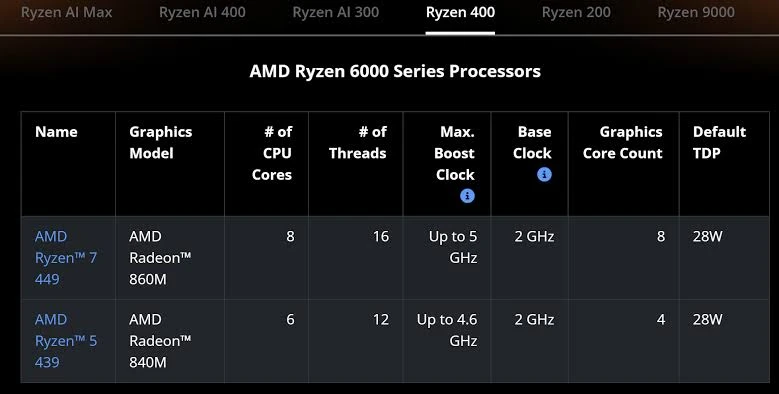
1. Ryzen 5 439
Shifting focus to the performance segment, this mid‑range chip provides a highly capable configuration for thin and light (thin and light) notebooks.
The die features 6 cores and 12 threads, built on a hybrid (hybrid) design that combines three high‑performance Zen 5 cores with three efficiency‑focused Zen 5c cores.
When it comes to clock speed, the Zen 5 cores can turbo up to 4.6 GHz for heavy tasks, while the Zen 5c cores run at 3.3 GHz to conserve power. The chip also includes an 8 MB cache L3 and is designed for a very efficient TDP of 28 W.
For visual processing, the chip includes an integrated Radeon 840M iGPU that offers 4 Compute Units (CU) based on the latest RDNA 3.5 architecture, with a boost clock of 2.8 GHz.
These specs are more than adequate for light video rendering and playing competitive game titles at 1080p with medium graphics settings.
2. AMD Ryzen 7 449
Users who need extra power for multitasking or for processor‑hungry applications will find this series a more sensible choice. The high‑end chip features a total of 8 cores and 16 threads, evenly split into 4 performance “Zen 5” cores and 4 efficiency “Zen 5c” cores.
Maximum clock speeds have been noticeably boosted; the performance cores can reach up to 5.0 GHz, while the efficiency cores operate at 3.4 GHz.
The interim storage capacity (cache L3) has also been increased to 16 MB for smoother data access, while the TDP limit remains around 28 W.
The graphics side also receives a boost. This variant is powered by a Radeon 860M iGPU that doubles the number of graphics cores to 8 RDNA 3.5 CUs, each running at 2.8 GHz.
The increase in CUs will be especially noticeable when playing modern AAA game titles with the help of FSR (FidelityFX Super Resolution) upscaling technology.
Ramalan Ketersediaan
Citing a report from Videocardz, no laptop manufacturer has so far openly announced any product based on these two unique processors.
Given the absence of the prestigious “Ryzen AI” label, both chip series are likely targeting the entry‑level to mainstream laptop market.
The retail price of devices using these chips is expected to be considerably more budget‑friendly than that of competing products.
Removing the AI features from these latest chips has turned out to be a breath of fresh air for consumers who simply want a fast laptop at a reasonable price.
To avoid missing out on update information about which laptop brands will be powered by these CPUs, be sure to keep an eye on the latest hardware news, gadget reviews, and PC building tips exclusively on TheCuy Tekno.
Frequently Asked Questions
What is the primary difference between these processors and the rest of the Ryzen AI 400 series?
The key difference is the absence of a Neural Processing Unit (NPU) on both processor models. Consequently, AI‑specific tasks are handled by the CPU or GPU rather than a dedicated chip.
Apakah kedua prosesor ini masih bisa diandalkan untuk bermain game?
Indeed. With the aid of the Radeon 800M iGPU based on the latest RDNA 3.5 architecture, both processors remain capable of handling game e-sports and game titles with certain graphical adjustments.
Apa arti dari inti Zen 5 dan Zen 5c?
This design uses a hybrid (hybrid) architecture. The Zen 5 cores are designed for maximum power in demanding applications, while the Zen 5c cores (c = compact) are smaller and focused on light tasks to save battery power.
Kapan laptop yang menggunakan prosesor Ryzen 5 439 atau Ryzen 7 449 akan tersedia di pasaran?
Kini, AMD maupun produsen laptop (OEM) belum mengumumkan jadwal peluncuran resmi maupun perkiraan harga untuk perangkat yang akan memakai kedua prosesor tersebut.
terimakasih sudah mengunjungi thecuy. 🙂

Penulis Berpengalaman 5 tahun.