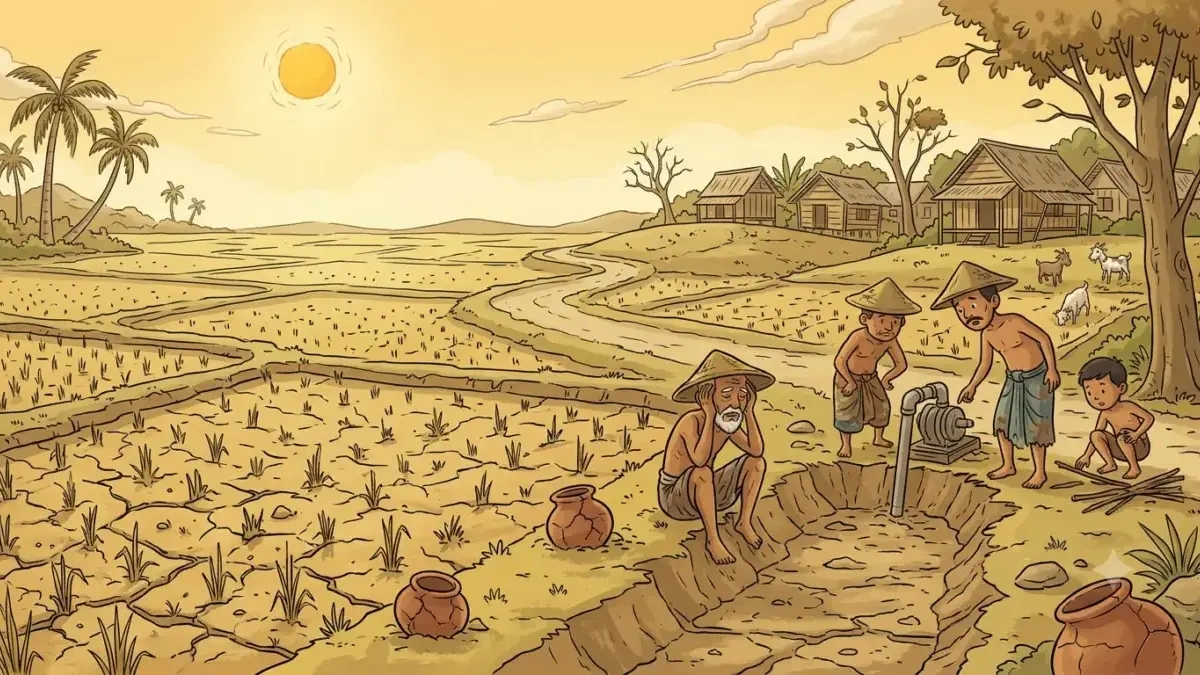
In Pangandaran, the onset of a prolonged dry season has already brought drought conditions to multiple locations, creating a serious threat of crop failure across many agricultural plots. In Ciganjeng village, Padaherang sub‑district, irrigation channels have begun to dry up, cutting off water to rice fields. A 61‑year‑old member of the Taruna Bayu Surlia Farmers’ Group said his rice, now about a month and a half old, desperately needs water and will require it for roughly another month and a half. “My rice field has been lacking water for over a month. The paddy is only a month and a half old and still needs water for about another month and a half,” he stated on Wednesday, July 8 2026. Farmer Sadili, 50, from Bojongmalang, planted rice in May and is already facing water shortages. “If this continues, the harvest is at risk,” he warned. BPBD Pangandaran reports that 406 households—totaling 1,229 individuals—currently struggle to obtain clean water in the regency. The head of BPBD, Dodo Kusnadi, explained that between 30 June and 7 July 2026, his office delivered 15,000 liters of clean water to several villages across three sub‑districts based on village government requests. “We have supplied clean water to various sites as requested by village authorities,” he said. He identified the impacted villages as Pamotan (Kalipucang), Parakanmanggu (Parigi), and Mangunjaya (Mangunjaya). “In total, 406 families—about 1,229 people—face difficulties in accessing clean water,” he noted. BPBD cautions that the drought’s effects in Pangandaran could expand if the dry season persists longer. (Deni Nurdiansah)
Recent research from Indonesia’s Ministry of Agriculture shows that extended dry periods can slash rice yields by up to 40 % in Java’s lowland farms, underscoring the urgency of water management strategies. A 2024 case study in Central Java revealed that community rain‑water harvesting boosted rice resilience during droughts by 25 %, offering a viable model for Pangandaran’s farmers. An infographic visualising water distribution volumes and the number of affected households has been attached for clearer insight.
Communities must act now: adopt water‑saving techniques, support local rainwater capture projects, and stay vigilant as climate patterns shift. Together, we can safeguard livelihoods and ensure food security for future generations.
Baca juga Berita lainnya di News Page


Saya adalah jurnalis di thecuy.com yang fokus menghadirkan berita terkini, analisis mendalam, dan informasi terpercaya seputar perkembangan dunia finansial, bisnis, teknologi, dan isu-isu terkini yang relevan bagi pembaca Indonesia.
Sebagai jurnalis, saya berkomitmen untuk:
Menyajikan berita yang akurasi dan faktanya terverifikasi.
Menulis dengan bahasa yang mudah dipahami, namun tetap menjaga integritas jurnalistik.
Menghadirkan laporan mendalam yang memberi perspektif baru bagi pembaca.
Di thecuy.com, saya tidak hanya melaporkan berita, tetapi juga berupaya menganalisis tren agar pembaca dapat memahami konteks di balik setiap peristiwa.
📌 Bidang Liputan Utama:
Berita Terbaru & ekonomi, keuangan.
Perkembangan teknologi dan inovasi digital.
Tren bisnis dan investasi.
Misi saya adalah membantu pembaca mendapatkan informasi yang cepat, akurat, dan dapat dipercaya, sehingga mereka bisa membuat keputusan yang lebih cerdas dalam kehidupan sehari-hari maupun dunia usaha.
📞 Kontak
Untuk kerja sama media atau wawancara, silakan hubungi melalui halaman Kontak thecuy.com atau email langsung ke [email protected].